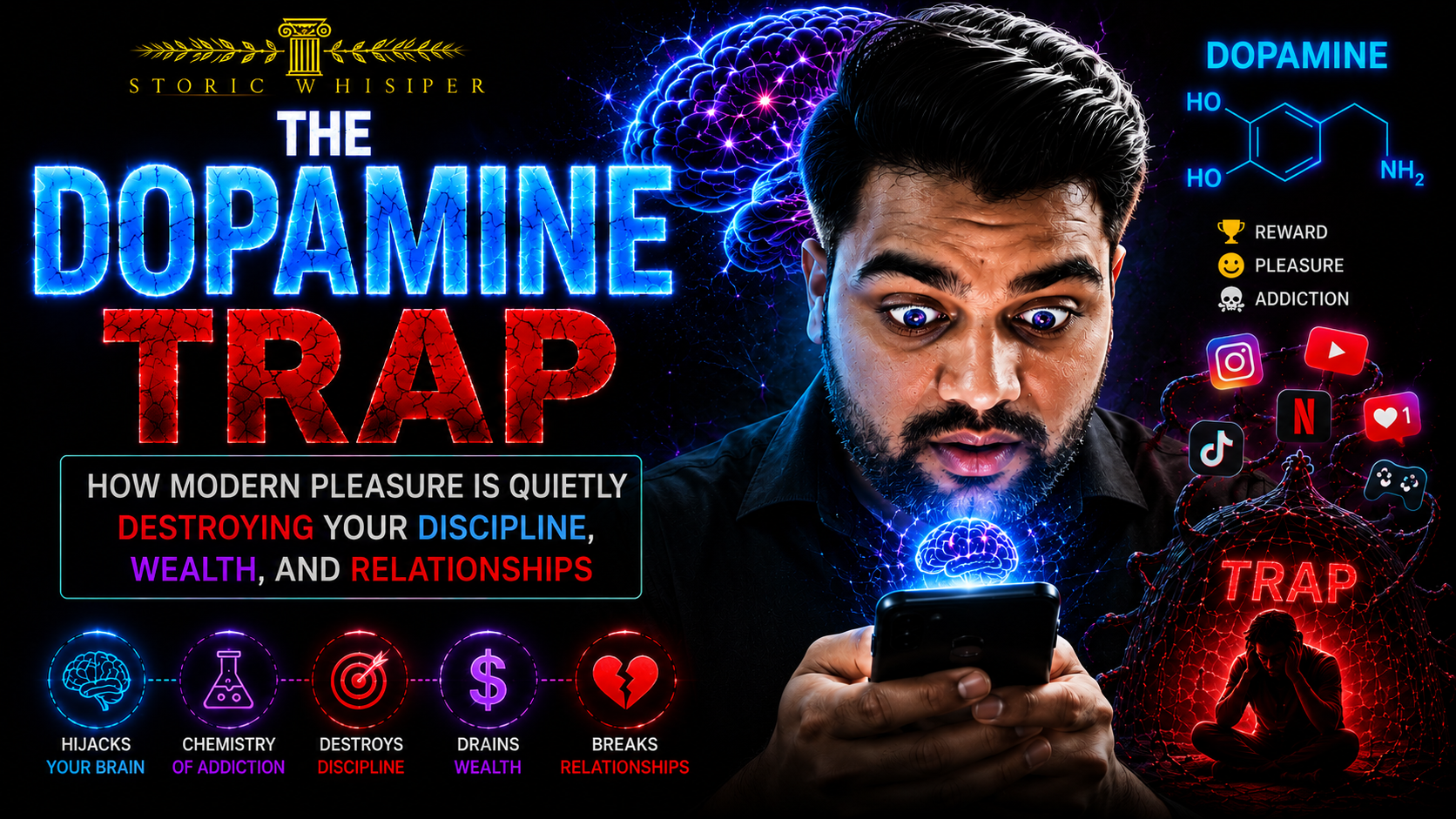
Good Dopamine vs Bad Dopamine: If Exercise and Cocaine (Drugs) Both Increase Dopamine, Why Does One Lead to Success While the Other Takes Away Your Freedom?
Meta: Exercise, Learning, Achievement, Drugs, Alcohol, Nicotine, and Social Media all increase dopamine. Discover the science of Good vs Bad Dopamine, Addiction, and Human Behavior.
Dopamine has become one of the most talked-about chemicals in modern psychology. It is often blamed for addiction, social media obsession, and unhealthy habits. At the same time, it is praised for motivation, achievement, and personal growth.
Imagine two radically different human realities unfolding at this exact moment. The first person is waking up at 4:00 AM in the freezing cold, dragging themselves out of a warm bed to hit the pavement. Their lungs are burning, their muscles are screaming for relief, but their gaze is locked onto the horizon with absolute focus and profound inner satisfaction. Now look at the second person. It is 2:00 PM in a dimly lit room. Their eyes are bloodshot, their hands are subtly shaking, and they are frantically pulling down on their smartphone screen for one more scroll—or worse, prepping their veins for the next hit of cocaine.
Now, prepare for the ultimate neurobiological plot twist: Both individuals are experiencing a massive release of the exact same chemical in their brains—dopamine.
This creates a profound paradox. If the same exact molecule drives the champion toward a legacy of excellence and the addict toward a living hell, then the chemical itself cannot be the villain. This leaves us with a hauntingly fascinating question:
If exercise increases dopamine and cocaine increases dopamine, why do their effects on human life look completely different?
Why does one help people become healthier, stronger, and more disciplined, while the other can utterly destroy self-control and create a state of absolute psychological slavery? The answer reveals an underlying, brutal truth about the human brain. The problem is not dopamine itself. The problem is exactly where that dopamine comes from, how fast it hits, and how it systematically alters the brain's reward architecture.
If you are reading this right now, pay close attention. You are about to uncover the dark psychological matrix that tech algorithms and illicit industries use to hijack your mind. If you do not learn the rules of this chemical game today, you will continue to hand over your focus, your energy, and your freedom to the highest bidder.
The Biggest Misunderstanding About Dopamine
Many people believe dopamine is the brain’s “happiness chemical.” Pop psychology has taught us that when we bite into a slice of pizza, get a like on a photo, or listen to our favorite track, the pleasure we feel is dopamine.
This is a massive scientific misconception.
Modern neuroscience suggests that dopamine is more closely connected to motivation, anticipation, and reward-seeking behavior than to happiness or pleasure itself. Dopamine does not say, "Wow, this feels amazing." Dopamine whispers, "Look at that! Run after it, capture it, consume it—because you need it to survive."
In simple terms: Dopamine makes you want something before it makes you enjoy it. It is the chemical of desire, pursuit, and the relentless chase. This explains why the human brain experiences a distinct surge of electricity during the anticipation phase rather than the consumption phase. Think about it:
- The intoxicating thrill right before buying a new car.
- The restless excitement while waiting for a new phone to arrive.
- The microsecond of intense focus right before opening a social media notification.
- The obsessive mental visualization right before receiving a promotion.
The brain's reward system often responds far more aggressively to the prediction of a reward than to the reward itself. The anticipation can sometimes feel infinitely stronger than the actual prize. That is the raw, unadulterated power of dopamine—and it is precisely where the trap is set.
Is There Really Such a Thing as Good Dopamine and Bad Dopamine?
Scientifically speaking, there is no official chemical distinction called “good dopamine” or “bad dopamine.” If you isolate a molecule of dopamine from a clinical patient, its chemical signature is identical regardless of the source.
Dopamine is the same neurotransmitter in every situation. What changes completely is the source, the intensity, and the temporal pattern of its stimulation. For practical, real-world understanding, we must categorize these pathways into two distinct forces:
Good Dopamine
Good dopamine is triggered by activities that force the brain to earn its chemical reward through effort. This pathway directly fosters long-term growth and aligns with a conscious process of self-transformation. It is characterized by activities that:
- Build high-value skills
- Improve metabolic and physical health
- Increase neuroplasticity and cognitive discipline
- Create sustainable, long-term personal growth
- Strengthen genuine self-respect and character
Examples include rigorous exercise, studying deep concepts, reading complex literature, building a business from scratch, and practicing a difficult skill over years.
Bad Dopamine
Bad dopamine is born from synthetic shortcuts that bypass the requirement of effort. It exploits the brain's evolutionary vulnerabilities, locking the individual into a destructive the dopamine trap. These activities are defined by their ability to:
- Deliver cheap, instant rewards with zero friction
- Encourage severe psychological dependency
- Erode executive functioning and self-control
- Hijack the attention span for commercial monetization
- Leave behind long-term neurological damage
Examples include hard drugs, excessive alcohol consumption, nicotine addiction, sports gambling, endless short-form video scrolling, and pornography.
The core issue is never the presence of the molecule. The critical issue is the source of the reward and what your brain's circuitry learns from repeated exposure to that source.
The Strange Connection Between Exercise and Cocaine
This is where the neurobiology becomes deeply fascinating. Both exercise and cocaine can drastically increase dopamine activity within the mesolimbic pathway—the brain's primary reward highway. Yet, their outcomes on human biology and destiny are completely polarized.
Why? Because the human brain responds not only to the presence of dopamine, but critically to the **intensity, speed, and pattern of its release, as well as the accompanying chemical cocktail.**
When you undergo physical exercise, dopamine levels rise in a gradual, measured, and balanced wave. Furthermore, exercise never floods the brain in isolation. It is systematically accompanied by an orchestra of life-enhancing compounds that govern adaptive Human Behavior:
- Endorphins: Natural painkillers that induce physical euphoria.
- Serotonin: The neurotransmitter of mood stability, pride, and emotional calm.
- BDNF (Brain-Derived Neurotrophic Factor): A miracle protein that repairs, grows, and protects brain cells.
- Enhanced Blood Flow: Delivering pristine oxygenation to the prefrontal cortex.
Cocaine, conversely, takes a sledgehammer to this delicate ecosystem. It does not produce a natural wave; it creates an instantaneous, unnatural tidal wave by chemically blocking the dopamine transporters that normally clean up excess neurotransmitters. The brain is flooded with a level of dopamine it was never evolutionary designed to handle.
The brain interprets this massive artificial surge as an unusually valuable reward—a survival jackpot. To protect itself from metabolic burnout, the brain begins a process called down-regulation, destroying its own dopamine receptors. Over time, this drastically reshapes motivation, personality, and executive decision-making.
Your Brain Evolved for Survival, Not for Instagram
To understand why we are so incredibly vulnerable to this modern hacking, we have to look through an evolutionary lens. For 99% of human history, our ancestors lived in environments of extreme scarcity. In that brutal tribal landscape, the dopamine system had a single, beautifully simple objective: Keep the organism alive.
Dopamine drove ancestral survival via strict evolutionary parameters:
- Finding calorie-dense food: Ripe berries or a successful hunt.
- Securing physical safety: Building shelters and outsmarting apex predators.
- Selecting reproductive partners: Ensuring the survival of the genetic lineage.
- Exploring hostile environments: Acquiring vital spatial and resource data.
In the ancient world, dopamine rewards were rare, fleeting, and required immense physical caloric expenditure. Fast forward to the modern era, and that exact same ancient brain architecture suddenly finds itself dropped into an artificial neon jungle engineered for hyper-stimulation. Today, we are assaulted by:
- Infinite scroll algorithms
- High-frequency short-form videos (Reels, TikTok, Shorts)
- Predictive, targeted push notifications
- Frictionless one-click online shopping
- Gamified trading and gambling applications
- Aggressive, ultra-processed dopamine-engineered foods
Your primitive brain has absolutely no defense mechanism against these stimuli. When you open a social media app or consume a modern drug, your ancestral reward loop genuinely believes it has killed a woolly mammoth or found a hidden oasis. It releases dopamine to lock in that behavior, totally unaware that you are simply rotting in a chair, letting your real world collapse around you. This is the genesis of the modern dopamine trap.
Slow Rewards vs. Fast Rewards: A Tale of Two Destinies
Let us closely analyze two archetype individuals in modern society to see how this chemical divergence plays out over time.
The First Person (The Growth Profile):
- Engages in intense physical exercise daily.
- Deliberately sits down to read dense, challenging books.
- Spends hours writing code or mastering a technical skill.
- Sacrifices current comfort to build a long-term business asset.
The Second Person (The Stimulation Profile):
- Constantly checks their phone within 30 seconds of waking up.
- Scrolls through short-form video feeds for hours on end.
- Demands instant entertainment the second boredom strikes.
- Relies entirely on external validation, quick fixes, and shallow consumption.
The profound scientific irony here is that **both individuals are successfully receiving dopamine.** Both of their neurological pathways are firing. However, their ultimate human destinies will look like entirely different species.
Why? Because the first person is utilizing the master principle of **Delayed Gratification**. They are embracing short-term friction in exchange for a highly stable, compounding baseline of success. The second person is a hostage to **Instant Gratification**. They demand the biological payout immediately, with zero effort. Because the human brain naturally defaults to the path of least resistance, it will always blindly prefer short-term stimulation over long-term growth—unless it is ruthlessly trained otherwise.
Why Alcohol, Nicotine, and Drugs Take Away Your Freedom
Addiction is vastly misunderstood by the public; it is not a simple, moral failure or a temporary lack of willpower. It is a severe structural rewiring of the brain's motivational hierarchy. Substances like alcohol, nicotine, and cocaine do not just provide a temporary high; they fundamentally rewrite the operating rules of the reward system.
When the brain is chronically bombarded by artificial surges of bad dopamine, its survival mechanisms sense an existential crisis. It realizes that the dopamine levels are high enough to cause neurotoxic damage. To adapt, the brain initiates a brutal survival counter-measure: it aggressively burns away its own dopamine receptors and cuts off its natural dopamine production.
This triggers the phenomenon known as Tolerance. Now, the baseline levels of dopamine inside the individual's brain drop catastrophically below the normal, natural human threshold. This brings about a clinical state of Anhedonia—the complete inability to feel joy from normal, everyday human things.
At this point, the individual is no longer chasing the drug or the bad habit for pleasure or fun. They are desperately chasing it just to climb out of a mental hellscape and feel a basic sense of "normalcy." Without it, they are hit with agonizing waves of anxiety, depression, and psychological withdrawal. This is the exact coordinate where human freedom is completely executed. You are no longer the king of your consciousness; you are a biological slave to a broken feedback loop. This structural captivity can run so deep that individuals feel completely paralyzed, a dark psychological pattern we analyzed heavily in our investigation on why you can't move on after a breakup.
Social Media is Not Cocaine... But It Shares a Dangerous Psychological Secret
To maintain absolute intellectual honesty, we must clarify that scrolling through Instagram is not chemically identical to consuming illicit class-A drugs. The biological degradation of your organs is vastly different. However, behavioral psychologists and Silicon Valley software engineers share a terrifyingly effective psychological engine with the casino industry: Variable Reward Schedules (Unpredictable Rewards).
Why does a desperate gambler sit in front of a slot machine for 14 hours straight, pulling a mechanical lever until their bank account is empty? Because of the agonizing, addictive beauty of the unknown. They do not know if the next pull will result in a total loss, a minor win, or a life-changing jackpot.
This exact loop has been seamlessly integrated into your smartphone applications. When you open an app and use your thumb to drag the feed downward to refresh, you are pulling the lever of a digital slot machine.
- You do not know what the next short video will be (A hilarious meme or a boring clip?).
- You do not know how many likes your recent post has accumulated.
- You do not know what a stranger commented on your profile.
- You do not know what notification is waiting behind that red badge.
The human brain absolutely thrives on this state of unpredictable suspense. It releases a constant, dripping stream of dopamine precisely to resolve the tension of the unknown. This is exactly why a conscious promise of “I will just check my notifications for 5 minutes” quietly morphs into 50 minutes of mindless scrolling, leaving you mentally drained and cognitively depleted. We are witnessing a quiet crisis where modern humans are surrendering their cognitive autonomy via cognitive offloading, handing over their independent thinking to cold, algorithmic feedback loops.
How to Identify Good Dopamine: The Self-Audit Test
You do not require expensive clinical assessments or neurological brain scans to figure out if your reward system has been compromised. You simply need to sit alone in a quiet room and perform a cold, calculated, and radically honest self-audit. Look at your daily habits, your digital consumption, and the relationships you maintain, and ask yourself this single foundational question:
"Is this specific source of reward making me stronger, more autonomous, and more capable over time? Or is it silently eroding my self-control and turning me into a desperate dependent?"
Let us look at the definitive biological markers to separate the two paths:
If a habit consistently:
- Upgrades your technical or mental skill sets
- Improves your long-term physical biomarkers and vitality
- Forges deep, unwavering internal discipline
- Increases your baseline self-respect when you look in the mirror
Then you are interacting with a pristine, highly sustainable source of Good Dopamine.
However, if a habit consistently:
- Strips away your executive willpower and choice
- Consumes massive blocks of non-renewable time
- Fractures your deep focus and leaves you chronically distracted
- Increases your emotional dependence on an external trigger
Then alarm bells should be ringing in your head. Your brain's reward system has been effectively hijacked, a crisis that will inevitably spill over and poison your core relationship dynamics.
The Dopamine Paradox
One of the most profound paradoxes in modern psychology is this: The exact same chemical that serves as the biological fuel for devastating addictions is the identical chemical that drives the highest heights of human achievement.
Today, ill-informed internet gurus and self-proclaimed motivational speakers yell from their platforms to "kill dopamine" or engage in absolute "dopamine elimination." This is dangerous nonsense. Without dopamine, human drive completely collapses; clinical studies show that when dopamine is entirely blocked in animals, they will literally starve to death even if food is placed centimeters away from their mouths. They lose the will to move.
It was this precise chemical hunger that built the modern world. Centuries ago, when ancient Stoics like Marcus Aurelius mastered their impulses or Seneca practiced deliberate austerity, they were fundamentally learning how to master this internal fire. Today, the timeless principles of stoicism serve as a psychological shield against modern over-stimulation. Dopamine is the reason why humanity:
- Built breathtaking, enduring civilizations out of raw dirt
- Pushed the frontiers of medical science to conquer ancient plagues
- Crossed treacherous, uncharted oceans on wooden ships
- Erected massive, disruptive global business empires
- Drove technological innovation to touch the surface of the moon
The problem is never, ever the existence of dopamine. The real crisis of the 21st century begins when this sacred evolutionary drive is stolen away from noble pursuits and completely captured by hollow, artificial systems. When your reward loop is weaponized to make you consume instead of create, it binds you instead of elevating you. It is the exact tool used in the underbelly of dark psychology to keep individuals blind, compliant, and profoundly dependent.
Final Thoughts
Exercise and cocaine may both heavily influence your internal dopamine pathways. But dopamine alone does not possess the moral power to dictate the final outcome of your life. It is merely the gasoline; you are the one steering the vehicle.
Therefore, the ultimate question you must ask yourself as a modern human navigating this hyper-stimulated world is never: "How much dopamine am I experiencing?" The definitive, life-altering question is:
"What kind of person is my dopamine system helping me become?"
One reward stream strengthens your skeletal discipline, psychological resilience, and long-term sovereignty. The other stream slowly rots your willpower, dissolves your attention span, and replaces your freedom with a cage of dependency. The future of your focus, your mental health, and your existential freedom depends entirely on your willingness to audit your sources.
But ask yourself... what if this dopamine trap, this relentless phone addiction, and this constant urge to escape reality run deeper than a simple chemical imbalance in your brain? What if your destructive habits are actually a symptom of a much darker, subconscious psychological armor? What if you aren't actually chasing dopamine at all, but rather using it to numbing a desperate, hidden hunger for external approval?
To understand this underlying deception, we must dive deep into the mechanics of validation psychology. There is a terrifying reality where an incomplete sense of self-worth forces brilliant individuals to sell their souls for cheap attention. We will tear down the curtain on this exact psychological warfare in our upcoming critical investigation. Until then, stand guard at the gates of your own reward system, and never trade your human freedom for a cheap chemical shortcut.
Is Your Mind Truly Free?
Have you ever watched your own willpower dissolve as you fell down a mindless multi-hour digital rabbit hole? Do you believe it is genuinely possible for a modern human to achieve absolute mastery over their reward system in a world engineered for distraction? Share your raw, unfiltered thoughts and personal battles in the comments below.