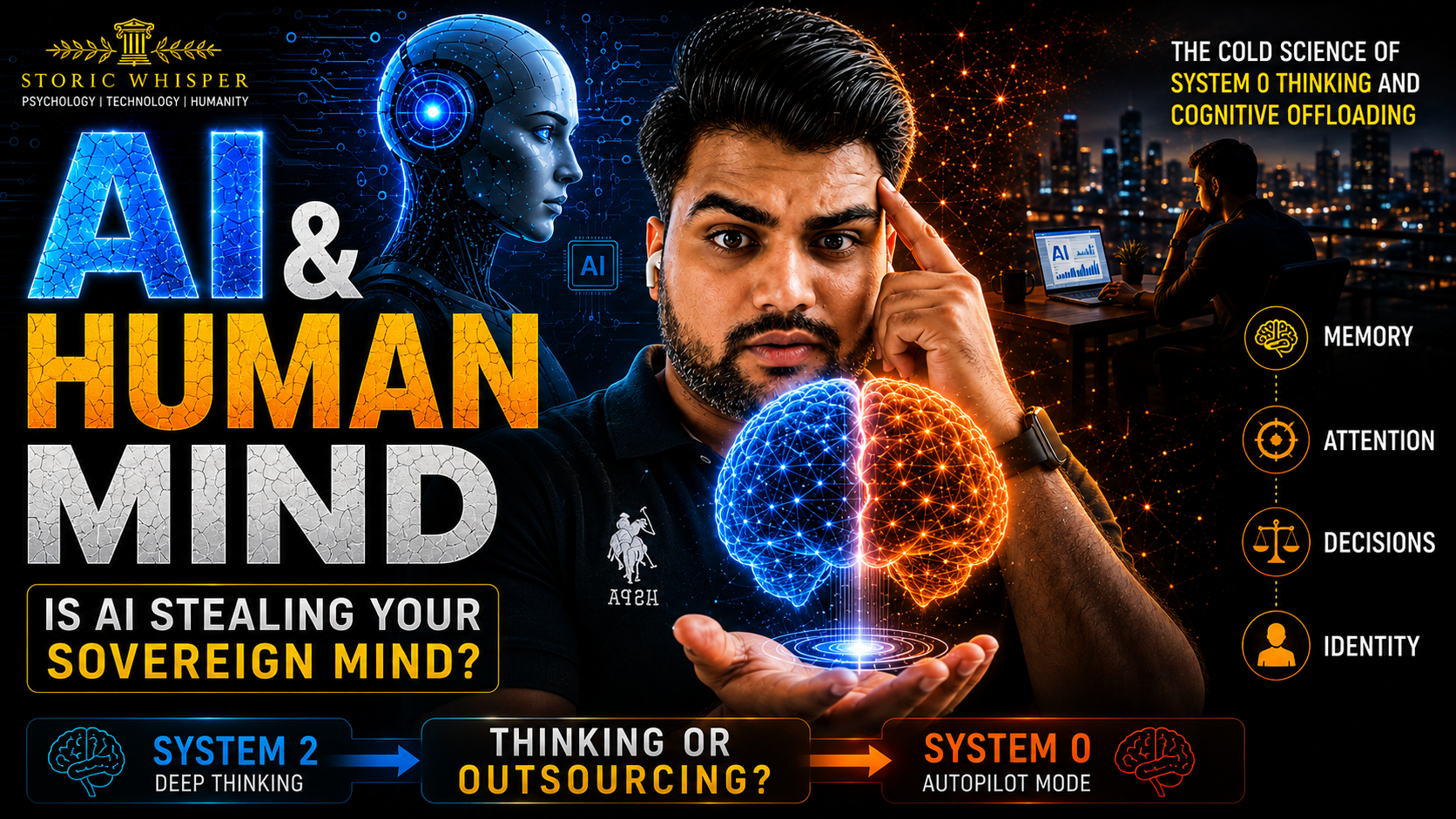
How AI Is Rewiring the Human Mind: The Hidden Psychological Revolution
The Biggest Psychological Experiment in Human History: The First Technology That Thinks With You
Throughout the grand arc of human history, the evolution of civilization has been defined by tools. The mastery of fire rewritten the rules of biological survival; the invention of the wheel exponentially expanded terrestrial mobility. The birth of the printing press democratized human knowledge, and the global arrival of the internet interwoven billions of isolated minds into a single, high-velocity digital network.
Yet, every revolutionary technology that preceded this moment shared one unyielding characteristic: it extended human capability without directly participating in human thought. A hammer amplifies the hand; a telescope sharpens the eye. Neither intervened in the underlying architecture of consciousness.
Artificial Intelligence has permanently broken that evolutionary equation.
For the first time in human history, humanity has engineered a technology that does not merely execute manual commands. Instead, it is capable of actively assisting, organizing, analyzing, and fundamentally influencing the complex cognitive processes that were once considered the exclusive, sacred domain of the biological mind.
Every single day, millions of individuals now engage in deep, bidirectional dialogues with advanced AI systems. They use these synthetic intelligences to brainstorm abstract ideas, summarize vast oceans of information, deconstruct intricate problems, formulate critical decisions, and structure the very fabric of their daily narratives.
This reality forces us to confront an extraordinary psychological dilemma: Is AI simply increasing human productivity, or is it quietly, systematically altering the neural architecture of the human mind itself?
The ultimate answer to this question will define the most significant psychological transformation of the twenty-first century. The true AI revolution is not taking place inside Silicon Valley server farms or complex algorithmic matrices. It is happening silently inside the human skull. This shift is deeply altering the foundational laws of Human Behavior.
AI Is No Longer Just a Tool: The Shift to a Thinking Partner
Previous technologies were designed to perform specific functions. A calculator performed calculations. A GPS system provided directions. A search engine helped locate information.
Artificial Intelligence operates differently. Instead of merely providing information, AI can organize it, analyze it, compare alternatives, generate possibilities, and simulate reasoning. This distinction matters.
[Traditional Technology: Linear Utility]
Human Input ──> Command ──> Static Machine Execution ──> Output

[Artificial Intelligence: Cognitive Partnership]
Human Input ──> Dialogue ──> Algorithmic Reasoning & Adaptation ──> Co-Created Synthesis
People are no longer using AI only as a utility. Increasingly, they are using it as a cognitive partner. Students use AI to create study frameworks. Entrepreneurs use it to evaluate business ideas. Writers use it to refine arguments and structure narratives. Professionals use it to process large amounts of information quickly.
In many situations, AI is becoming part of the thinking process itself. And that represents a profound shift in the relationship between humans and technology.
The Rise of Cognitive Outsourcing: The Age of External Thinking
Human beings have always relied on external systems to extend mental capacity. Writing allowed people to store information outside the brain. Libraries preserved collective knowledge. Digital devices enabled instant access to vast amounts of information.
Psychologists often describe this process as cognitive offloading—the transfer of mental tasks to external tools. AI takes this process much further. People are no longer outsourcing memory alone.
They are outsourcing:
- Information organization and architectural synthesis
- Idea generation and creative frameworks
- Advanced research assistance and contextual parsing
- Complex problem analysis and logical deduplication
- Strategic decision support and predictive mapping
In some cases, individuals are even using AI to clarify thoughts they struggle to articulate themselves. This marks the emergence of a new phenomenon: external thinking. Rather than simply storing information outside the brain, people are beginning to externalize parts of cognition itself.
The implications of this shift are still being explored. But it may represent one of the most important psychological changes of the modern era. To reverse this structural dependency and rebuild an unshakeable inner compass, one must delve deeply into the underlying mechanics of The Science of Self Transformation.
Why Convenience Changes the Brain: The Evolution of Cognitive Atrophy
Human beings are naturally drawn toward efficiency. The brain is designed to conserve energy whenever possible. When two paths exist—one difficult and one easy—most people instinctively choose the path requiring less effort. Technology has always exploited this tendency. Cars reduced physical effort. GPS reduced navigational effort. Search engines reduced information-search effort.
Artificial Intelligence reduces cognitive effort. Tasks that once required hours of research can now be completed in minutes. Complex topics can be summarized instantly. Ideas can be generated on demand. This convenience is undeniably powerful. But every form of convenience creates trade-offs.
The Principle of Neuroplasticity: When a mental skill or neural pathway is used less frequently, the brain systematically down-regulates its efficiency, making it weaker over time.
The critical question is whether AI will merely enhance thinking or gradually reduce the need for certain forms of mental effort. This frictionless immediate reward architecture closely mirrors the neural vulnerabilities exploited by The Dopamine Trap, turning independent critical thought into an automated, outsourced commodity.
The Emergence of the Second Brain: From Artifact to Agent
Many people describe AI as a digital assistant. Increasingly, however, it functions more like a second brain. It remembers information. It organizes knowledge. It generates insights. It provides instant access to structured thinking.
For many users, AI is becoming a cognitive extension rather than a simple application. This development is unprecedented. Throughout history, external systems stored information. Today, external systems are beginning to participate in reasoning processes. The distinction is subtle but significant.
A notebook remembers. An AI system helps think. That difference may fundamentally alter the way future generations interact with knowledge itself.
A New Cognitive Era: The Architecture of Biological Independence
Humanity stands at the beginning of a new cognitive era. Artificial Intelligence has the potential to amplify creativity, accelerate learning, and enhance decision-making on an unprecedented scale. At the same time, it introduces questions no previous technology has forced humanity to confront.
What happens when thinking becomes increasingly assisted? What happens when problem-solving becomes increasingly automated? What happens when intelligence is no longer entirely biological?
These questions extend far beyond technology. They touch the foundations of psychology, cognition, learning, and human identity. The future of AI will not be determined solely by algorithms. It will also be determined by how human beings choose to integrate those algorithms into their minds, preventing the silent decay into subconscious manipulation detailed in our guide to Dark Psychology.
Conclusion: The Most Important Question of the AI Age
Artificial Intelligence is more than a technological breakthrough. It is a cognitive event. For the first time in history, an external intelligence is becoming part of everyday human thought. Whether this leads to greater intellectual freedom or greater dependency remains uncertain.
But one thing is clear: The most important transformation of the AI age may not occur inside machines. It may occur inside the human mind. And the defining question of the coming decades will be simple:
Will AI become an extension of human intelligence—or a substitute for it?
Storic Whisper — Psychology without the noise.
To contextualize this cognitive shift within the broader spectrum of behavioral evolution and mental health, review our foundational catalog at Storic Whisper All Articles or visit our dedicated AI Mind Hub.
➡️ Next Strategic Read
Are you ready to unpack the invisible systems engineering your mental stagnancy and keeping you under algorithmic submission? Protect your focus and deep dive into our core analysis: The Architecture of Control: Decoding the Hidden Forces of Psychological Stagnation.