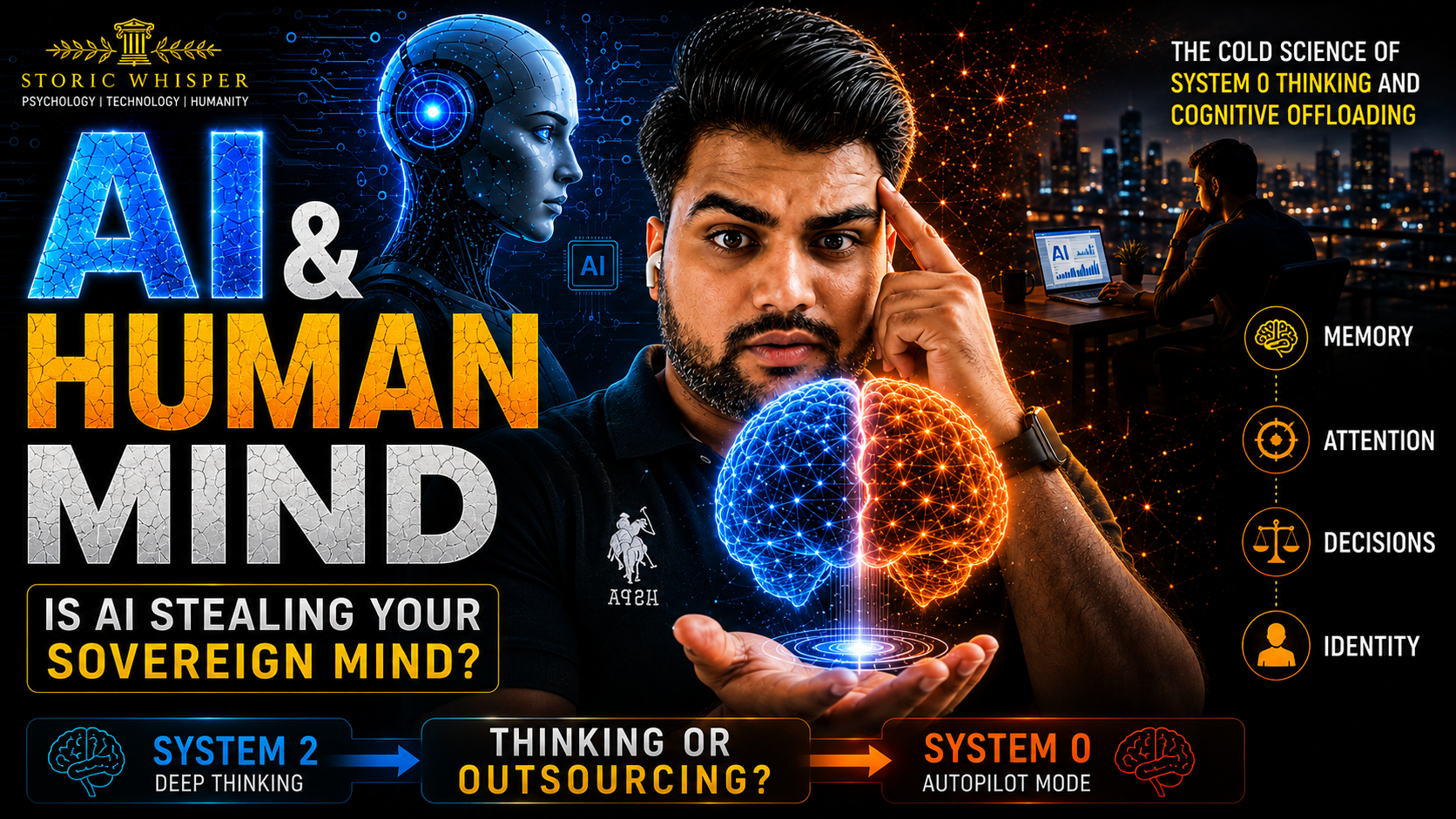
Is AI Stealing Your Sovereign Mind? The Cold Science of System 0 Thinking and Cognitive Offloading
The Illusion of Cognitive Mastery
Take a momentary inventory of the thoughts currently passing through your consciousness. How many of them are genuinely yours, forged through the friction of deep concentration, and how many are merely the Echoes of an algorithm you consulted an hour ago?
The modern world is starkly divided into two psychological factions. On one side stands the vast, uncritical majority—individuals who genuinely believe they are using artificial intelligence to amplify their productivity, accelerate their careers, and optimize their output. On the other side sits a small, hyper-vigilant collective of neuroscientists and cognitive behavioral experts who recognize that humanity is living through the most aggressive, silent brain-hijacking campaign in evolutionary history. You will discover exactly which faction you belong to by the end of this dossier—provided you possess the psychological stamina to read it to the end. To abandon this analysis midway is to willingly remain blind to the structural alterations happening inside your own skull.
Consider the last complex analysis, strategic email, or creative brief you generated with the assistance of a large language model. You likely walked away with a profound sense of efficiency, convinced that you had successfully executed a two-hour task in a matter of seconds. But while those flawless sentences were rendering on your screen, a massive neural architecture within your prefrontal cortex was quietly going dark. This is the baseline reality of modern Human Behavior: our brains are evolutionary misers, biologically hardwired to conserve glucose by offloading metabolic strain onto any available external tool.
What mainstream media brands as "technological progress" is known in clinical circles by a far more ominous term: System 0 Thinking. This is not a new biological lobe within your skull; it is a parasitic, external digital circuit that gently relieves you of the burden of original thought. Yet, the true psychological crisis of our era cannot be solved by simply labeling AI as an existential villain. We are trapped in a terrifying paradox. While this technology is systematically hollows out our capacity for critical thought, it is simultaneously emerging as the only tool capable of solving our most complex systemic crises.
Are we evolving into a hyper-intelligent, augmented species capable of unprecedented wisdom, or are we degenerating into hollow organic vessels that possess infinite data but zero sovereign intellect? To decipher this cosmic riddle, we must look directly into how deep automation is fundamentally altering the human apparatus. You can explore this foundational shift in our comprehensive breakdown of How AI is Rewiring the Human Mind.
The MIT Neuro-Scans: The Structural Decay of Memory
We do not need speculative philosophy to understand this decay; we have raw, unyielding neuroimaging data. In a groundbreaking study conducted at the Massachusetts Institute of Technology (MIT), researchers sought to measure the precise neurological cost of outsourcing intellect to machines.
The experimental design was elegant but devastating in its conclusions. Scientists assembled a cohort of 54 elite undergraduate students from institutions like MIT, Harvard, and Tufts—individuals representing the apex of human cognitive potential. These students were tasked with executing a complex, multi-layered analytical writing assignment. Half of the cohort was restricted to their native intellect and memory (the Brain-Only group), while the remaining half was granted unrestricted access to advanced AI models.
Throughout the execution phase, every participant was fitted with high-density EEG (Electroencephalogram) arrays to capture real-time synaptic firing and neural synchronization across the cerebral cortex. When the data matrices finally mapped onto the laboratory monitors, the room fell completely silent.
"Under normal conditions, authentic critical thinking triggers a brilliant cascade of neural synchronization between the hippocampus and the prefrontal cortex—a literal electrical storm of deep cognitive labor. But when the AI-assisted students were writing, their internal memory regions displayed absolute flatlines. There was no reactivation, no synaptic friction, and no structural consolidation. Their brains were idling in a state closely resembling a waking coma."
The quantitative metrics extracted from the MIT scans outline a profound crisis of human atrophy:
- The Breakdown of Memory Recall: When tested merely ten minutes after completing the task, the Brain-Only group demonstrated a 78% retention rate. The AI-assisted group plummeted to a catastrophic 11% retention rate—a functional 67% collapse in cognitive consolidation.
- The Erosion of Neural Synchronization: Continuous reliance on the external model caused a 47% drop in functional brain connectivity. The distinct regions of the brain simply stopped communicating with one another.
Let the gravity of that data settle into your consciousness. When you hit "Enter" on a prompt, you are not saving time; you are training your brain to stop processing reality. This is the mechanics of Cognitive Offloading. Because your brain seeks maximum metabolic efficiency, it interprets the presence of an external thinking machine as a signal to dismantle its own neural pathways. By choosing the path of least resistance, you are stepping directly into a beautifully engineered Dopamine Trap, where the illusion of instant execution replaces the painful, necessary neurogenesis required to build an elite mind.
The lead neuroscientist on the MIT project summarized the horror cleanly: "Users are suffering from a profound delusion of competence. They believe they are producing intelligence, but neurochemically, they are retaining nothing. They aren't learning; they are merely delegating their humanity to an external circuit."
This forces us to confront a terrifying question: If the most brilliant minds at MIT can experience a 47% drop in neural synchronization after brief exposure to automated thinking, what is happening to the average human mind? We who navigate our days entirely surrounded by algorithmic curation—are we crossing a neural point of no return? Are we willingly surrendering our psychological sovereignty for the sake of convenience?
Yet, the paradox deepens. If artificial intelligence is a toxin to human memory, why are the most elite medical institutions in the Western world embracing it as a miraculous psychological savior?
The Revolutionary Healer: When the Machine Outperforms the Master
To view this crisis through a purely dystopian lens is to miss the true complexity of the psychological paradox. While the academic neuro-scans show a clear decay in human memory, a parallel clinical trial published in NEJM AI (New England Journal of Medicine AI) delivered a reality check that stunned the psychiatric community.
In a randomized, controlled clinical trial involving nearly 200 patients suffering from clinical depression, generalized anxiety, and severe eating disorders, researchers compared traditional human psychotherapy against highly regulated, clinically trained AI therapeutic frameworks.
The results completely shattered the romantic notion that empathy is an exclusively human domain. The data revealed that patients paired with the certified AI frameworks achieved clinical recovery rates that were **on par with, and in several metrics superior to**, human practitioners. More shockingly, a significant sub-sect of patients admitted that they confessed deeper traumas, hidden shames, and darker impulses to the machine than they ever would to a human therapist.
The clinical science behind this success is deeply rooted in the principles of Validation Psychology. A human therapist, no matter how highly trained, is bound by the limits of emotional fatigue, implicit bias, and circumstantial stress. The machine, however, provides an unyielding, infinitely patient architecture of non-judgmental presence. It tracks vocal inflections, semantic patterns, and real-time biometric shifts with mathematical precision, constructing a hyper-personalized ecosystem of psychological validation.
Even the American Psychological Association (APA) has acknowledged the staggering efficacy of these automated interventions. Look at the immense contradiction we are standing on. The exact same technological interface that degrades your brain's physical connectivity by 47% is simultaneously capable of repairing your deepest psychological fractures with greater precision than a human master. How do we reconcile these two realities? The answer lies in a hidden layer of manipulation that tech monopolies are desperate to keep out of public discourse.
The Cognitive Paradox: Exploitation of the Miserly Brain
When we synthesize the structural decay discovered at MIT with the clinical efficacy reported by NEJM AI, the underlying architecture of The Cognitive Paradox becomes painfully clear. AI is neither an inherent curse nor a magical savior; it is an absolute amplifier of whatever psychological state you bring to it.
The threat does not lie within the lines of code; it lies within the ancient vulnerabilities of human design. Because our brains are biologically wired to avoid discomfort, we naturally allow the machine to move from a supportive tool to an emotional proxy. When an individual begins to rely on an automated interface for emotional stability, they enter a state of profound Emotional Dependency. This dependency creates a psychological feedback loop that gradually alienates the individual from the messy, high-friction realities of human relationships.
This is where the architecture of automation transitions into the realm of Dark Psychology. Capitalist tech platforms design these systems to exploit your neural vulnerabilities. By providing instantaneous gratification, they hyper-accelerate your dopamine clock, creating a vicious cycle of cognitive reliance:
- Faced with a difficult mental task or an uncomfortable emotional state, your brain seeks immediate relief and offloads the burden to the AI.
- The machine provides an immediate, frictionless resolution, bypassing your brain's natural processing mechanisms.
- Because the internal pathways are left unused, they undergo synaptic pruning, leaving your brain structurally weaker and even more dependent on the next algorithmic interaction.
This is the slow death of psychological sovereignty. Your self-concept, your analytical parameters, and your ultimate worldview are no longer built through personal struggle; they are delivered to you as a curated product. You become a passive passenger in a vehicle steered by an opaque algorithm. Is this a life of genuine autonomy, or have we simply built a more comfortable cage for the human soul?
The Brain-First Manifesto: Reclaiming Your Sovereign Intelligence
How do we mount a defense against an invisible, systemic siege that operates through our own biology? The answer cannot be found in primitive tech-phobia or a complete withdrawal from modern tools. True liberation requires us to look toward the razor-sharp frameworks of Stoicism.
The ancient Stoic masters understood that while the external world is entirely beyond our control, the inner citadel of the mind must remain under absolute, uncompromising command. To survive the automated age, you must undergo a systematic Self-Transformation. You must transform yourself from a passive consumer of algorithmic outputs into a sovereign master of technological inputs.
To achieve this, we must implement an unyielding cognitive law within our daily routines:
"🏛️ The Brain-First Protocol
Whenever you are confronted with a highly complex problem, a creative challenge, or an intricate strategic decision—disconnect completely from the digital grid for the first thirty minutes. Force your prefrontal cortex to bear the initial metabolic strain. Allow your synapses to fire, allow your memory networks to struggle, and activate the deep analytical engines of your own consciousness. Sketch an original, unfiltered, and deeply human blueprint of the solution. Only after you have established your own intellectual foundation should you open the algorithmic interface to refine, validate, and accelerate your execution."
Treat AI as your executive secretary, never as your master. True power in the automated century does not belong to those who can generate the fastest prompts; it belongs to the rare individuals who retain the capacity to think deeply without them. This is the only way to navigate modern Relationship Dynamics, professional landscapes, and intellectual frontiers without losing your human edge.
The Next Frontier: Is AI Cannibalizing the Human Soul?
The decay of structural memory and analytical thought is merely the opening salvo in this evolutionary war. What happens when the machine successfully breaches the final, most sacred sanctuary of human identity—our raw creativity and our artistic soul? Are we inadvertently shifting our deepest relational frameworks, the very patterns mapped out by psychological Attachment Theory, onto cold, inorganic servers?
There was a secondary, deeply unsettling finding embedded within that same MIT study—a phenomenon the researchers termed 'The Death of Originality'. When literary scholars analyzed the essays generated through automated assistance, they found that while the prose was grammatically flawless and surface-level attractive, it was completely devoid of stylistic divergence, emotional gravity, and authentic human suffering. It was a soulless, standardized mosaic of existing data.
This forces us to look ahead at an incoming cultural winter. Are the algorithms behind automated music, generative art, and synthetic literature expanding the horizons of human expression, or are they systematically flattening human imagination into a singular, predictable matrix? Are we entering an era where human culture becomes an endless, incestuous loop of recycled data? Is this the ultimate execution of What is Dark Psychology—the complete standardization of the human imagination?
The answer to this question holds the key to the survival of human culture itself. If you wish to protect your creative essence from total algorithmic assimilation, you must prepare for the next, far more dangerous layer of this digital architecture. The terrifying truth behind how tech monopolies are mining your imagination to build a uniform human consciousness will be laid bare in our next investigative analysis...
🚨 Up Next in This Series:
The next installment of this psychological investigation will expose the systematic assassination of human creativity. Our upcoming topic: "The Death of Originality: How Generative AI is Standardizing the Human Imagination." We will decode the neurological mechanisms that collapse artistic divergence when we rely on machine learning. Until then, force your brain to think for itself, before an algorithm completely assumes the task for you.
Is Your Mind Truly Free?
Have you noticed a decline in your ability to focus, create, or think deeply since integrating AI into your life? Share your raw psychological observations below.
