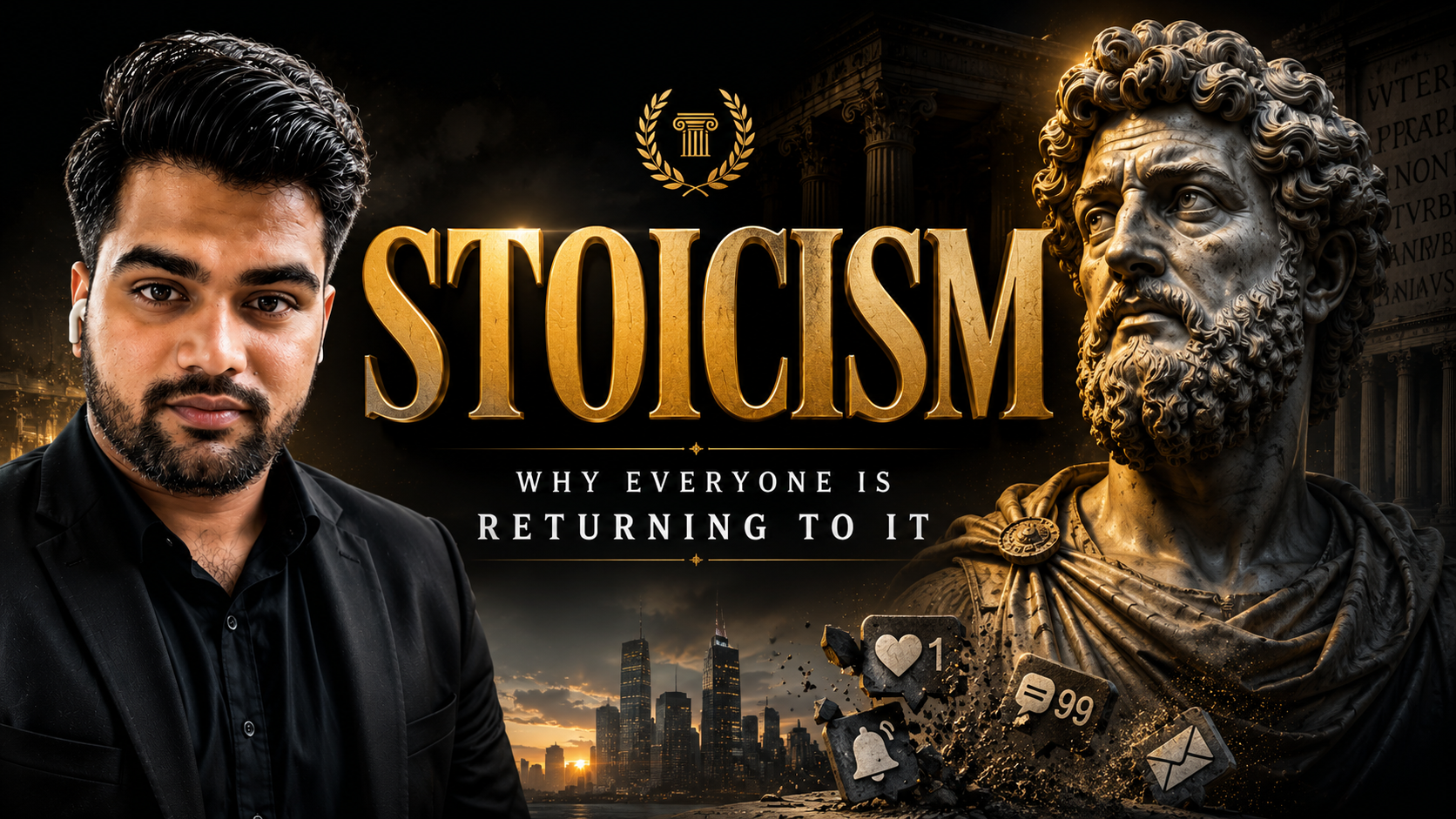
Why Is Stoicism Becoming So Popular in the Modern World?
It is 3:00 AM. You are staring at the glowing screen of your smartphone, trapped in an endless loop of doomscrolling. Your inbox is flooded with unread corporate emails, your social media feed is packed with curated, artificial projections of "perfect lives," and your chest feels heavy with a familiar, lingering anxiety: "Am I doing enough? How do I survive tomorrow’s uncertainty?"
We live in the most technologically advanced, materially comfortable, and hyper-connected era in human history. Yet, the dark irony of the 21st century is that we are also the most distracted, exhausted, and anxious generation to ever walk the earth. Modern life has transformed into a high-pressure cooker where the constant demand for optimization and severe information overload have hollowed out our mental peace. In this digital chaos, individuals are rapidly losing control over their own attention and emotional stability. To address this exact psychological fracture, timeless rules of internal sovereignty are required to shield the modern mind from burnout.
Amidst this raging mental epidemic, a quiet revolution is taking place. From the elite software engineers of Silicon Valley to high-performing corporate executives and young digital natives, thousands are turning away from trendy self-help hacks. Instead, they are seeking refuge in a 2,300-year-old Hellenistic philosophy.
This begs a critical question: Why are the teachings of Marcus Aurelius (a Roman Emperor), Seneca (a wealthy statesman), and Epictetus (a disabled former slave)—written in times of physical plagues, brutal warfare, and literal exile—suddenly going viral in a world of AI and hyper-automation? Why is the modern intellectual treating this ancient philosophy as the ultimate DIY Mental Health Tool? Is it merely a passing aesthetic trend, or does it hold the master key to restructuring our core human behavior?
Let’s dissect this phenomenon through the lens of cognitive neuroscience and contemporary psychology.
1. The Relentless Positivity Trap and Contemporary Burnout
Toxic Positivity vs. Radical Acceptance
Modern culture feeds us a dangerous, manufactured illusion: "Always stay positive, manifest your desires, and eliminate negative thoughts." Social media algorithms and hustle-culture gurus have built a toxic ecosystem where feeling tired, sad, or uncertain is treated as a personal failure.
But standard human psychology does not operate on a binary switch of forced optimism. When the harsh friction of reality crashes into this forced cheerfulness, it creates acute cognitive dissonance, leading directly to psychological burnout. Today's individual is constantly chasing an invisible, chemically engineered reward—a validation loop driven entirely by notifications and algorithmic approval. This modern neurological maze creates an endless loop that continuously erodes long-term willpower.
When the brain gets fried by this endless chemical race, the illusion shatters. To truly understand the mechanics of addiction, focus, and neurological calibration, one must look deep into how short-term digital gratification completely rewires our mental baseline.
Stoicism is exploding in popularity because it serves as a radical antidote to toxic positivity. The Stoics never promise that "everything will be fine." Instead, they practice what modern psychologists call Radical Acceptance. They look straight into the worst-case scenarios, strip them of emotional hyperbole, and accept reality exactly as it is. When you stop fighting things outside your direct control, half of your anxiety evaporates instantly. While modern algorithms condition us to react to every single stimulus, Stoicism trains us to observe silently and respond with cold, calculated logic.
2. The Hidden Blueprint of Cognitive Behavioral Therapy (CBT)
From Ancient Porches to Modern Clinical Psychology
Stoicism is frequently misunderstood as an abstract academic philosophy discussed in ivory towers. In reality, it is the foundational bedrock of modern clinical psychology. If you visit a top-tier psychotherapist today for anxiety, panic disorders, or clinical depression, the most empirically validated framework they will use to treat you is CBT (Cognitive Behavioral Therapy).
What most people don't know is that CBT was explicitly modeled after Stoic principles. Dr. Albert Ellis, the pioneer who laid the groundwork for modern cognitive therapies, openly stated that his system was inspired by Epictetus. The core thesis of both CBT and Stoicism can be summarized in one definitive psychological law:
"Men are disturbed not by things, but by the view which they take of them."
If you go through a traumatic breakup or experience a sudden corporate layoff, the event itself is fundamentally neutral. It is a data point. However, the internal narrative your mind constructs around that data point—"My life is ruined," "I am a total failure," "I will never be happy again"—is the exact source of your psychological suffering.
When an intimate relationship collapses, human logic completely surrenders to emotional hijacking, trapping the subconscious mind in a loop of grief and obsession. The brain under trauma actively refuses to let go, dragging the individual through cycles of emotional codependency. Stoicism teaches us to intercept our thoughts before they turn into these destructive internal narratives. It is not an academic philosophy; it is an active neuro-hack for psychological invincibility.
3. A Surgical Strike on Rumination: The Birkbeck University Discovery
Quantifying Emotional Resilience Through Stoic Training
Because the modern, educated demographic demands scientific validation over philosophical speculation, a groundbreaking study conducted by the Birkbeck Affective and Cognitive Neuroscience Laboratory at the University of London provided empirical proof of Stoicism's efficacy.
Researchers monitored individuals who scored exceptionally high on scales measuring vulnerability to clinical anxiety and chronic depression. These participants underwent a structured, multi-week online training program rooted entirely in core Stoic exercises. The quantified data stunned the scientific community:
- 13% to 18% Drastic Reduction in Rumination: Rumination is the toxic mental habit of chewing on past mistakes or simulating future catastrophes over and over again. Cognitive science identifies rumination as the primary engine driving depression. Stoic training effectively broke this cognitive loop.
- 15% Surge in Self-Efficacy: Participants demonstrated a massive increase in their perceived capacity to handle unexpected life stressors and maintain decisive action under pressure.
This study proved that actively dismantling a fragile, anxiety-ridden personality is a systematic science. Re-programming the mind from scratch is completely possible when using the right objective analytical tools.
Commenting on the empirical results of the study, Professor Nazanin Derakshan noted:
"In an era of chronic uncertainty and unremitting stress, where resilience has become a survival necessity, Stoic training offers a highly accessible and demonstrably reliable path to safeguarding and optimizing emotional health."
4. 'Tech Bros' and the Silicon Valley Revival
DIY Mental Health and the Masculine Alternative to Therapy
The modern renaissance of Stoicism has a fascinating social demographic: it has become an absolute cult within the tech industry, startup incubators, and high-frequency trading floors. Why are the world’s most pragmatic, data-driven minds obsessed with Marcus Aurelius?
The tech landscape looks glamorous from the outside, but underneath the high compensations lies a brutal environment of cutthroat competition, volatile market shifts, sleep deprivation, and extreme burnout. Furthermore, with the rapid acceleration of Artificial Intelligence (AI), professional obsolescence and existential anxiety have scaled exponentially.
In this hyper-accelerated pressure cooker, Stoicism acts as a high-performance DIY Mental Health Tool. Traditional therapy models often require a vulnerability framework centered around emotional expression, venting, and unpacking trauma. While highly effective, many pragmatic individuals—particularly men within the tech space—find this approach alienating.
Stoicism offers a "muscular," deeply logical alternative. It doesn't ask you to suppress your feelings; it provides an analytical dashboard to manage them using logic, objective observation, and ruthless productivity. It allows an individual to win their internal psychological warfare autonomously, without feeling weak or dependent.
5. The "Stone-Heart" Myth: Decoding Stoic Emotional Intelligence
Domestication of Emotions vs. Pathological Suppression
The single biggest misconception about Stoicism in popular culture is the definition of the word "stoic" itself. People assume that becoming a Stoic means turning into a cold, emotionless robot—a sociopathic stone wall that feels no love, no grief, and no joy.
This is a complete psychological misunderstanding. Stoicism does not advocate for the elimination of emotion; it advocates for the domestication of emotion.
An authentic Stoic feels emotional waves just as intensely as any other human being. The difference lies in the response latency. When a chaotic emotion (like blind rage or crushing panic) strikes an untrained mind, the individual instantly identifies with the emotion and acts upon it, sabotaging their own life.
When that same wave strikes a Stoic, they observe the emotion, label it objectively, and use their rational faculty to decide whether that emotion deserves to dictate their reality. As documented in the Conatus - Journal of Philosophy (2023), the personal journals of Seneca and Marcus Aurelius reveal men deeply acquainted with profound grief, sorrow, and human vulnerability. Stoicism doesn't forbid you from weeping; it prevents your tears from drowning your rational mind for the rest of your life.
6. The Dichotomy of Control: The Ultimate Modern Filter
Drawing the Immutable Line in the Mental Sand
If you were to compress the entire cosmic architecture of Stoic philosophy into a single, operational tool for daily survival, it would be the **Dichotomy of Control**.
As Epictetus famously stated at the opening of his Enchiridion:
"Some things are in our control and others not. Things in our control are opinion, pursuit, desire, aversion, and, in a word, whatever are our own actions. Things not in our control are body, property, reputation, command, and, in one word, whatever are not our own actions."
The psychological crisis of the digital age stems from the fact that 90% of our daily mental energy is hyper-focused on things entirely outside our direct control: viral trends, algorithmic feedback, geopolitical volatility, corporate restructuring, and the unpredictable opinions of strangers online. When you attempt to exert control over external variables, clinical anxiety is the mathematically guaranteed outcome.
Stoicism teaches the modern generation to draw an unbreachable line in the sand. It serves as a brutal reminder that the moment you anchor your peace of mind to external validation, algorithmic likes, or social approval, you have willingly handed over the remote control of your emotional sovereignty to a chaotic, uncaring world.
Conclusion: Are You the Sovereign of Your Own Mind?
The Architecture of an Invincible Mind
The modern resurgence of Stoicism is not a fleeting internet aesthetic or a temporary self-help fad; it is an evolutionary survival mechanism for the human psyche. This philosophy transcends religion, geography, and time because it communicates directly with the foundational algorithms of human nature.
It stands as an absolute reminder that no matter how chaotic the external world becomes—regardless of mass corporate layoffs, societal polarization, or the intense pressure of digital existence—you possess an unbreachable "Inner Citadel." The world outside cannot crack this fortress unless you willingly open the gates and surrender the keys to your rational mind.
The next time your brain transforms into an anxiety factory at 3:00 AM, put the smartphone down, look into the dark, and ask yourself one definitive Stoic question: "Is this variable within my direct control? If the answer is no, why am I allowing it to rob me of my sovereign peace?"
In the next installment of this psychological series, we will launch a direct assault on the defining cultural virus of our time—"The Validation Addiction Cure: Why a True Stoic is Immune to the Hunger for External Approval." Stay calibrated.
