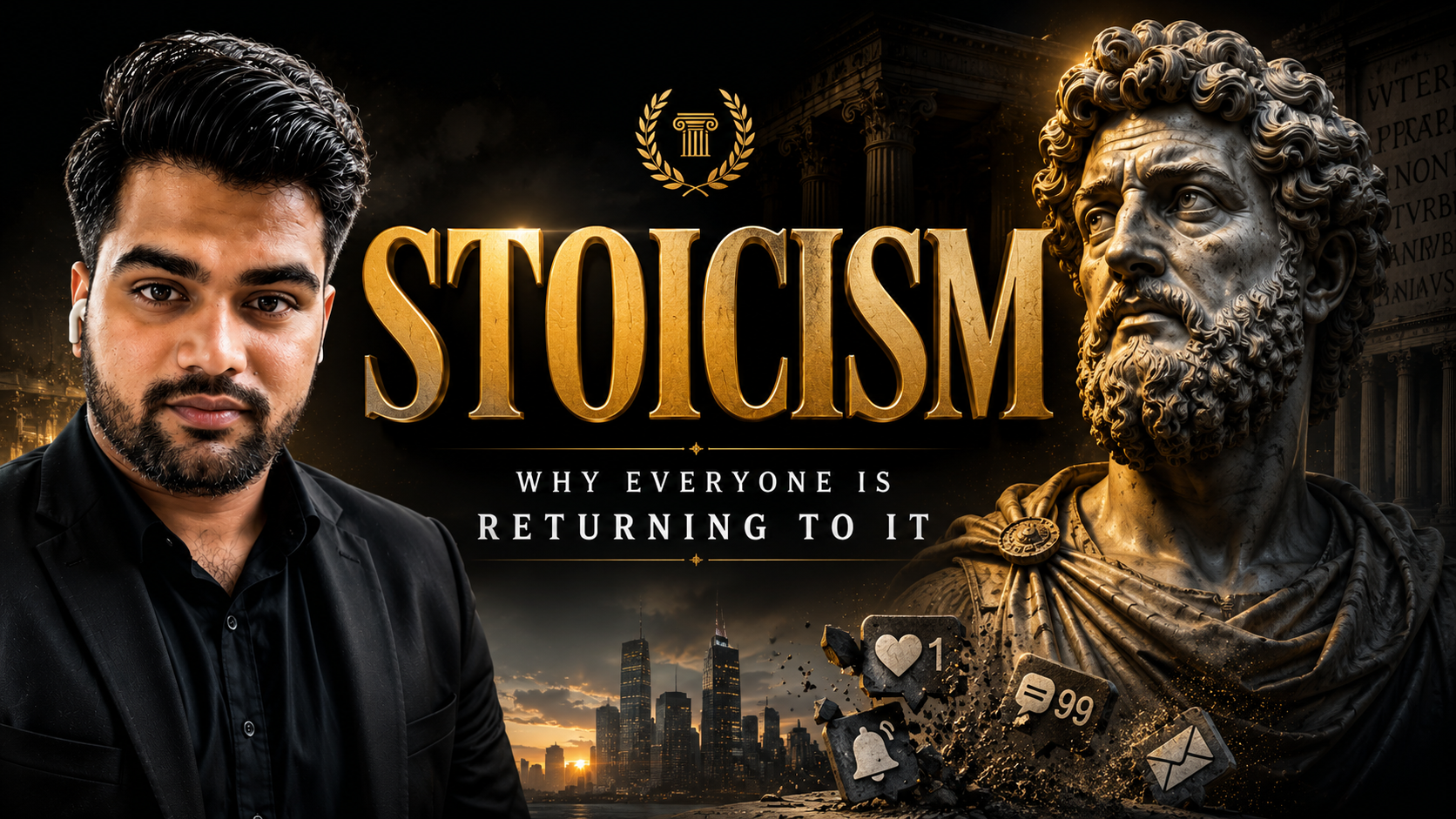
Can You Love Without Emotional Dependency? What Stoicism Teaches About Love, Attachment, and Freedom
1. The Accidental Hostage: The Modern Romantic Delusion
Conjure the image of the person you claim to love most in this world. Now, subject your psyche to a brutal, unvarnished interrogation: If tomorrow morning they walked out of your life forever—by choice, by betrayal, or by the cold finality of death—would your identity survive the collapse? Would you remain psychologically intact, or would you crumble into an existential void?
If the mere thought of this isolation sends a visceral wave of anxiety through your chest, you are experiencing the reality of a modern cultural sickness. Our society has systematically romanticized emotional addiction. Through music, cinema, and literature, we are conditioned to believe that "I am nothing without you" is the ultimate declaration of devotion. We have mistaken structural neediness for profound affection, unknowingly walking into a beautifully disguised cage of emotional dependency.
But when we filter human intimacy through the unyielding lens of ancient philosophy, a startling paradox emerges: The Stoic Matrix of Intimacy.
Pop culture frequently slanders Stoicism as a cold, unfeeling doctrine practiced by emotional stone walls who suppress their humanity in dark rooms. This raises a fascinating question: Why is Stoicism becoming so popular in the modern era if it is seemingly so detached? The answer is simple: the ancient masters were not anti-love; they viewed authentic affection as an essential law of nature. What they fiercely opposed, however, was the voluntary mental enslavement that masquerades as romance in our modern era. They proposed a radical, terrifyingly beautiful question: Is it possible to adore someone with the entirety of your soul, yet remain so internally sovereign that their departure cannot steal your peace?
2. Detached Devotion: How Roman Emperors and Slaves Viewed Intimacy
To understand how a Stoic processes romance, we must discard our contemporary definitions of affection and look at the core principles of human behavior. For thinkers like Marcus Aurelius, Seneca, and Epictetus, the human experience was governed by a cosmic sympathy—an interconnectedness that commands us to protect and cherish our social structures, including our romantic partnerships.
Seneca openly wrote about the deep necessity of forging authentic bonds, famously stating that the remedy for a cold heart is to love generously. Marcus Aurelius, the leader of the Western world, spent pages of his private journals reminding himself to love the people destiny surrounded him with, viewing human cooperation as a biological mandate. Epictetus, who endured the horrors of physical slavery before winning his freedom, taught that our capacity for mutual affection is precisely what elevates our species above brute animals.
Yet, these same men issued harrowing warnings about the fragility of external attachments. They did not fear love; they feared the psychological blindness that causes a person to hand the keys to their self-worth over to an external entity. They understood that the moment you cross the line from loving someone to relying on them for your fundamental stability, you cease to be a partner and instead become a psychological hostage. To understand the profound depth of this cognitive shift, one must analyze the hyper-modern phenomenon of the human mind AI connection, which demonstrates the same contemporary patterns of outsourcing our core mental faculties to external forces.
3. The Axis of Sovereignty: Dismantling the Illusion of Control
If you desire to insulate your relationships from chronic anxiety and toxic control cycles, you must master the absolute foundational pillar of Stoic philosophy. This requires a deep dive into the architecture of control.
As Epictetus explicitly detailed in his teachings, reality is ruthlessly split into two distinct territories:
- Internal Realities: Your voluntary thoughts, your judgments, your desires, your moral character, and your emotional reactions.
- External Realities: The weather, global economies, physical decay, and crucially—the thoughts, fidelity, choices, and emotional states of your partner.
When you map this rigid metric onto modern relationship dynamics, the root cause of our relationship anxiety becomes glaringly obvious. When you demand that your partner must never change, that they must constantly validate your existence, or that their mood must mirror your desires, you are attempting the impossible task of commanding an external reality.
The realization is a violent but liberating awakening for the psyche: You have spent your entire life agonizing over variables you possess zero structural control over. You cannot force someone to remain loyal; you cannot reprogram their subconscious mind to always prioritize you. The frantic effort to secure this control is what drives the desperate cycle of emotional reliance. The moment you accept that your partner is an entirely independent agent, the desperate need to dominate their choices dissolves, giving way to authentic emotional freedom.
4. The Four Horsemen of Dependency: A Stoic Deconstruction
Stoicism does not indulge in gentle relationship counseling; it diagnoses our relational dysfunctions with surgical, borderline brutal clarity. From a Stoic viewpoint, what we commonly call "intense passion" is often a toxic cocktail produced by our internal insecurities.
When we unpack emotional dependency through this philosophical lens, we find that it is driven by four dark psychological forces:
- The Validation Trap: Exploiting your partner as an unpaid mirror to continually validate your fragile ego because your internal self-worth is hollow.
- Chronic Neediness: An inability to stand firmly within your own skin, forcing another human being to become a crutch for your existential loneliness.
- Smothering Possessiveness: Treating a sovereign individual as a piece of private property, reducing their liberty to pacify your internal terrors.
- The Phobic Dread of Loss: Living in a perpetual state of anticipatory grief, letting the fear of a potential breakup destroy the beauty of the present moment.
Academic research in philosophical psychology confirms that anchoring your peace to an external attachment drastically accelerates your psychological fragility. You become an intricate glass palace waiting to be shattered by a single unreturned text. By choosing the path of least resistance and seeking constant digital or emotional reassurance, you step directly into the dopamine trap, where the illusion of instant emotional execution replaces the necessary growth required to build an elite mind.
Seneca famously warned that any individual who builds their life on unstable external foundations will live in a constant state of panic—and a mind paralyzed by panic is fundamentally incapable of genuine, selfless love.
5. The Myth of the Cold Stoic: Emotional Resilience vs. Apathy
Here we must confront and dismantle the most pervasive misconception surrounding this philosophy: the dangerous lie that Stoicism demands total emotional eradication. This distortion causes thousands of people to flee from the philosophy, assuming it transforms human beings into robotic monoliths.
To truly understand how we build these toxic defenses, we must look at the foundational blueprints of human psychology laid out in attachment theory. Let us set the record straight by drawing a sharp line between two vastly different states of existence:
- Apathy and Suppression (The False Stoic): This is a state of psychological defense where an individual, traumatized by past rejection or an anxious background, builds a wall around their heart. They refuse to feel, refuse to connect, and treat people with deliberate coldness out of sheer cowardice.
- Resilient Devotion (The True Stoic): This is a state of profound courage where you love your partner completely, immerse yourself in their presence, and demonstrate fierce loyalty, while remaining completely aware that they are a temporary loan from the universe.
There is an immense structural difference between refusing to feel and refusing to be destroyed by what you feel. The authentic Stoic lover does not blunt their emotions; they refine their judgments. They enjoy the blossom without tearing it from the branch, transforming their affection from a desperate grasp for survival into a clean, unburdened celebration of the other person's existence.
6. The Clinical Validation: The Birkbeck Framework
Lest you think these concepts are merely outdated thoughts from long-dead philosophers, modern clinical science has recently delivered an extraordinary validation of Stoic relationship ethics. Landmark research conducted through institutional frameworks like Birkbeck, University of London, alongside extensive neurological data, shows a flawless convergence between ancient Stoicism and cutting-edge psychological therapy.
When modern clinical psychotherapists treat individuals shattered by obsessive codependency or devastating relational trauma, they do not rely on vague advice. They utilize modalities like Cognitive Behavioral Therapy (CBT), which is built entirely upon the Stoic premise that our suffering is caused not by external events, but by our cognitive judgments about those events.
The empirical data from these clinical trials reveals that individuals who apply these core tenets experience a drastic reduction in emotional dependency. They stop looking at their partners through the lens of frantic survival and begin engaging with them through the lens of deliberate choice. Two millennia before the invention of the modern consulting room, these ancient philosophers mapped the exact neural mechanics required to cure the human heart of addictive attachment.
7. The Radical Stoic Law: Premeditating the End of Love
We now arrive at the most polarizing, emotionally challenging concept in the entire Stoic lexicon—a principle that feels almost sacrilegious to our modern romantic sensibilities, yet holds the absolute secret to total emotional sovereignty.
Epictetus delivered a shocking instruction to his students that remains a viral cultural trigger to this day. He advised that when you kiss your child, your spouse, or your lover goodnight, you must silently remind yourself: "This being is mortal. They do not belong to me. Tomorrow, they may be reclaimed."
In our current culture, this is labeled as morbid, cynical, or unfeeling. But in the theater of control and cognitive survival, this practice—known as Premeditatio Malorum (the premeditation of adversity)—is the ultimate act of psychological liberation.
When you fail to practice this awareness, you expose your mind to the mechanics of dark psychology. Captalistic relationship expectations exploit your neural vulnerabilities, turning a beautiful partnership into a system of subtle manipulation. By consciously confronting the impermanence of your relationship, you sever the roots of psychological ownership. You love them as an independent entity, a sovereign soul walking alongside you on a shared journey, rather than a shadow cast by your own ego.
8. The Sovereign Citadel: Loving Without Losing Yourself
Ultimately, Stoicism does not instruct us to close our hearts or live in cold isolation. It does not ask you to love less; it commands you to love with such towering strength that your love ceases to be an existential liability. It invites you into an elite tier of human intimacy where you can achieve profound self-transformation. It allows you to say to your partner: "I do not need you to survive. My identity is complete without you. And precisely because my space is whole, my choice to love you is entirely pure."
This is the blueprint for real internal freedom. It strips away the desperate bargains of codependency and replaces them with an unshakeable inner citadel, allowing you to experience the terrifying beauty of romance without committing psychological suicide.
But as we close this specific investigation, we must peer into an even deeper, darker cavern of the human psyche. What if your agonizing inability to detach, your obsessive need for security, and your paralyzing fear of abandonment have nothing to do with love at all? What if you are completely misdiagnosing your pain?
What if the terrifying reality is that your relationship isn't a bond of affection, but an absolute, unvarnished craving for approval? To fully grasp this, you must unlock the mechanics of validation psychology, the subtle force that dictates why we seek external confirmation to soothe internal wounds. What if the crisis isn't your partner's behavior, but a foundational fracture inside your own sense of self-worth?
🚨 Up Next in This Investigative Series:
Our next analysis will take a dark, uncompromising look into the mirrors of your subconscious mind. We will crack open the definitive topic: "Validation Addiction: Are You Truly in Love, or Just Begging for Self-Worth?" We will expose how early psychological wounds manifest as romantic obsession, and provide the clinical steps to rebuild your inner kingdom from scratch. Stay sovereign, guard your mind, and never let your identity become someone else's shadow.
Has Your Identity Blended Into Someone Else's Shadow?
Have you ever experienced a relationship where the boundary between love and total emotional dependency completely vanished? Do you believe it is truly possible to love someone deeply while remaining entirely detached from their choices? Share your raw, unfiltered thoughts and psychological experiences in the comments below.