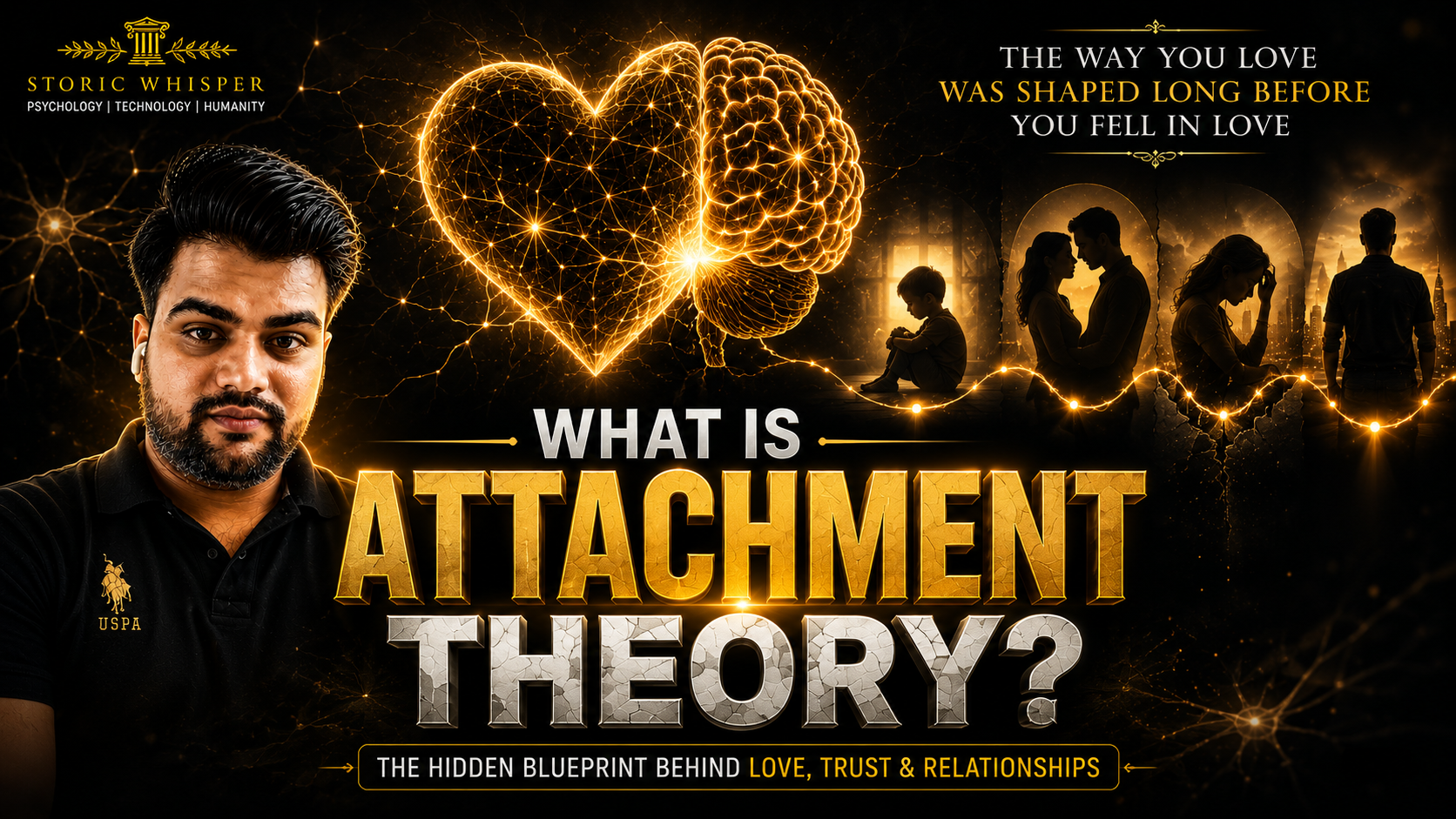
What Is Attachment Theory? The Hidden Blueprint Behind Love, Trust, and Human Relationships
Love is often described as unpredictable.
People say the heart wants what it wants.
Some believe relationships are driven by chemistry. Others blame luck, timing, or fate.
Yet psychology tells a very different story.
Why do some people trust easily while others struggle to open up?
Why do some feel secure in relationships while others constantly fear being abandoned?
Why can two people experience the same relationship but react to it in completely different ways?
The answer may lie in one of the most influential ideas in modern psychology: Attachment Theory.
Far from being just another relationship concept, Attachment Theory offers a framework for understanding how human beings connect, trust, love, and respond to emotional closeness throughout their lives.
It reveals that many of our relationship patterns are not random at all. They often follow emotional blueprints that were formed long before we became aware of them.
What Is Attachment Theory? Understanding the Science of Human Connection
Attachment Theory is a psychological framework that explains how human beings form emotional bonds and why those bonds play such a powerful role throughout life.
The theory was developed by British psychiatrist and psychoanalyst John Bowlby, who believed that attachment is not simply an emotional preference.
It is a biological necessity.
Human beings are born with an innate need to connect with others.
From the earliest moments of life, the brain begins searching for safety, protection, and emotional security.
Attachment is the system that helps us find it.
According to Bowlby, our earliest experiences with caregivers gradually shape the way we understand relationships, trust, emotional closeness, and even ourselves.
These experiences become the foundation upon which future relationships are built.
Why Humans Are Wired for Attachment: The Evolutionary Need for Connection
Imagine a newborn child left completely alone.
Unlike many animals, human infants cannot survive independently.
For years they depend on caregivers for food, protection, comfort, and emotional regulation.
From an evolutionary perspective, attachment developed as a survival mechanism.
A child who stayed close to a protective caregiver had a better chance of survival than one who did not.
Over thousands of generations, the human brain evolved to seek connection.
This is why emotional bonds feel so important.
We are not merely social creatures.
We are biologically designed for connection.
The need to belong is not a weakness.
It is part of being human.
The Birth of Attachment Theory: How John Bowlby Changed Psychology
Before Attachment Theory became widely accepted, many psychologists underestimated the importance of early emotional relationships.
Bowlby challenged that view.
After observing children who experienced separation, neglect, or inconsistent caregiving, he noticed a pattern.
The quality of early relationships appeared to influence emotional development far beyond childhood.
Children who experienced reliability and emotional availability often developed greater confidence and emotional stability.
Children who experienced unpredictability often carried insecurity into later stages of life.
This observation transformed how psychologists viewed relationships.
Attachment was no longer seen as a temporary childhood phenomenon.
It became recognized as a lifelong psychological system.
The Invisible Maps We Carry: Internal Working Models Explained
One of the most powerful concepts within Attachment Theory is something known as Internal Working Models.
Think of them as emotional maps.
Throughout life, the brain collects information about relationships and gradually forms expectations. Questions such as:
- Can people be trusted?
- Am I worthy of love?
- Will others support me when I need them?
- Is emotional closeness safe?
Rarely do we consciously ask these questions. Yet our minds are constantly answering them.
Over time, those answers become deeply embedded patterns that influence how we interpret relationships and respond to emotional experiences. Left unexamined, these psychological structures act as the architecture of control, dictating our romantic choices from behind the scenes.
Two people can enter the same relationship and experience it completely differently because they are operating from different internal models.
How Attachment Shapes Personality: More Than Just Relationships
Many people think Attachment Theory only explains romantic relationships. In reality, its influence extends much further. Attachment affects:
- Trust and interpersonal vulnerability
- Emotional regulation and stress response
- Self-esteem and core identity
- Communication patterns and boundaries
- Conflict management and resolution
- Decision-making under pressure
- Social confidence in professional environments
The way we respond to closeness, rejection, uncertainty, and emotional intimacy is often connected to the attachment patterns we have developed over time.
This is why understanding attachment is not simply about understanding relationships. It is also the ultimate catalyst for anyone pursuing what is self-transformation, allowing us to accurately map and reprogram our behavioral defaults.
Love, Trust, and Emotional Security: The Foundations of Healthy Relationships
Most people focus on the visible parts of relationships. Communication. Compatibility. Shared interests. Attraction. These factors certainly matter.
But beneath them lies something deeper: Emotional security.
Attachment Theory suggests that one of the primary goals of close relationships is the creation of a secure emotional base.
When people feel emotionally safe, they are more likely to trust, communicate honestly, and navigate challenges effectively. When emotional security is absent, relationships often become unstable regardless of how strong the attraction may be.
This is one reason why relationships cannot be explained by chemistry alone. Connection is not only about passion. It is also about psychological safety—a state of mental clarity and emotional resilience heavily emphasized in our deep dive into why is stoicism becoming so popular in the modern world.
The Four Attachment Styles: Different Ways People Experience Connection
As research expanded, psychologists identified four major attachment styles. These styles represent different patterns of thinking, feeling, and behaving within relationships.
| Attachment Style | Core Psychological Definition |
|---|---|
| Secure Attachment | Individuals feel comfortable with both intimacy and independence. |
| Anxious Attachment | Individuals often fear rejection or abandonment and may seek constant reassurance. |
| Avoidant Attachment | Individuals value independence but may struggle with emotional closeness. |
| Disorganized Attachment | Individuals desire connection but simultaneously fear it. |
These attachment styles influence everything from communication patterns to relationship expectations.
However, each style deserves a deeper discussion of its own. For now, it is enough to understand that not everyone experiences relationships in the same way.
Why Attachment Theory Matters More Than Ever: Understanding Relationships in the Modern World
Technology has transformed how people communicate. Dating apps have changed how people meet. Social media has changed how people interact.
Yet the human need for connection remains exactly the same. People still seek acceptance. People still fear rejection. People still want emotional security.
Modern tools may have changed the landscape of relationships, but they have not changed the psychological systems that drive them. In an era where automated frameworks alter our social interfaces, understanding the intersection of technology and psychology becomes critical—as explored in our architectural analysis of the Human Mind and AI.
Understanding Attachment Theory helps explain why many relationship struggles continue to appear across generations despite changing technology and social norms.
Conclusion: The Hidden Patterns Behind Human Relationships
Attachment Theory is far more than a theory about childhood. It is a theory about human connection itself. It helps explain why people love differently. Why people trust differently. Why some relationships feel safe while others feel chaotic.
Most importantly, it reminds us that our relationship patterns are rarely random. Behind every connection lies a deeper psychological structure that shapes how we experience love, trust, intimacy, and belonging.
But this raises an even more fascinating question.
If attachment influences the way we connect with others, why do some people become terrified of abandonment while others avoid emotional closeness altogether?
The answer lies within the attachment styles themselves. And understanding them may completely change the way you see relationships.
Storic Whisper — Psychology without the noise.
➡️ Next Strategic Read
How does the evolving architecture of technology exploit these ancient, vulnerable attachment systems within your biological mind? Continue your cognitive expansion and step directly into our definitive analytical framework: Human Mind and AI: Decoding the Psychological Shift.