The Architecture of Alignment: Decoding the Invisible Force Fields of Human Relationships
Storic Whisper • Global Psychology Edition
Have you ever witnessed a couple that, on paper, possesses every metric of modern validation—wealth, aesthetic symmetry, and social status—yet behind closed doors, their shared reality is a freezing, silent war zone? Conversely, you have likely seen pairs who navigate the exact same socioeconomic stressors, who clash with raw, unedited friction, yet their foundational bond only hardens like titanium over time.
This contrast forces an unsettling psychological question: Why do two human beings enter the exact same structural container of a relationship, yet one collective nervous system thrives while the other systematically self-destructs?
The mainstream romantic narrative offers a lazy, superficial answer: Love. We are conditioned to believe that if the sentiment is pure and the initial chemical rush is intense, the trajectory of the connection will organically self-correct. But behavioral science and neurobiology reveal a much colder reality. Love, in its isolated emotional state, has an incredibly low survival rate. It is merely the entry portal.
Beneath the surface of every human intersection lies a complex network of invisible currents, ancient survival blueprints, and chemical feedback loops. Psychology calls this hidden matrix Relationship Dynamics. If you do not learn to audit these invisible currents within your own life, you will spend your years acting as a helpless passenger in a vehicle driven by your unhealed past—a systemic vulnerability we dissect in The Architecture of Control: Decoding the Hidden Forces of Psychological Stagnation.
Part 1: The Invisible System (What Are Relationship Dynamics?)
To truly comprehend relationship dynamics, you must first discard the notion that a connection between two people is a linear equation. It is not. A relationship is a living, breathing, emergent psychological ecosystem.
When two autonomous individuals choose intimacy, they do not arrive empty-handed. They bring an invisible cargo: their childhood attachment histories, their uncataloged emotional defense mechanisms, and their unique neurochemical baselines. The intersection of these two distinct operating systems gives birth to a third, separate entity: the Behavioral Dynamic. This dynamic operates on a continuous feedback loop.
[The Feedback Blueprint]
Individual A (Core Trauma) ──> Behavioral Output (Action)
                                       │
                                       ▼
Individual B (Core Trauma) ──> Reactive Counter-Output (Reaction)
                                       │
                                       ▼
                         [The Permanent Dynamic]
In behavioral psychology, this is known as an interpersonal system. Once a dynamic crystallizes, it dictates how both parties communicate during a crisis, how they negotiate boundaries, and how much psychological safety they afford each other.
When a dynamic becomes toxic, both individuals experience a radical shift in their Locus of Control. Your daily emotional equilibrium ceases to be your own property; it becomes a hostage to the micro-expressions, shifts in tone, and unpredictable moods of your partner. When this dependency crosses a critical threshold, it mutates into total subjugation, a dark state explored in our clinical study on What is Emotional Dependency? When Your Happiness Becomes Someone Else’s Slave.
Part 2: The Currency of Intimacy (The Four Primitive Emotional Needs)
The great illusion of modern dating is that human beings are searching for an idealized concept of romance. In reality, the subconscious mind is hunting for something far more primal. Behind the grand performance of "falling in love" lies a desperate, calculated search to satisfy four non-negotiable Primitive Emotional Needs.
1. The Matrix of Comprehension (To Be Understood)
This expands far beyond intellectual agreement. It is the profound reassurance that when your nervous system is dysregulated—when you are irritable, defensive, or retreating into silence—your partner can look past the surface-level symptom and accurately read the underlying vulnerability.
2. The Auditory Void (To Be Heard)
In a modern culture optimized for immediate judgment and defensive counter-arguments, true active listening is an endangered currency. The subconscious craves a safe harbor where thoughts can be spoken without the immediate threat of cross-examination or premature minimization.
3. The Validation Premium (To Be Significant)
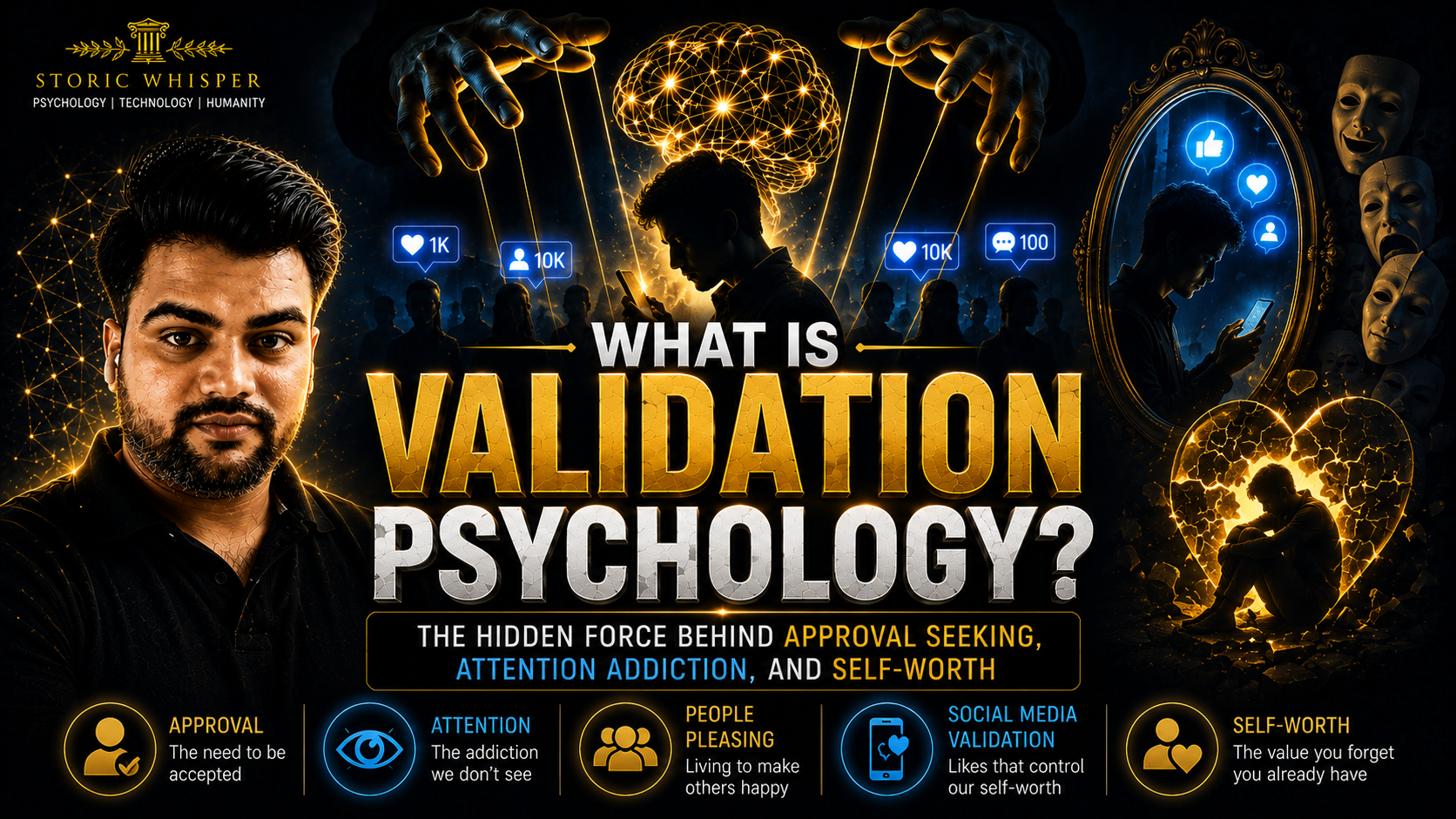
Every human operating system requires confirmation of its own value. Within a dynamic, this means knowing that your perspective carries weight and your presence alters the room. This deep-seated human hunger is detailed in our psychological breakdown of What is Validation Psychology? The Hidden Force Behind Self-Worth.
4. Psychological Sanctuary (Emotional Safety)
True emotional safety means possessing the freedom to expose your unedited self—your deepest insecurities and your historical shames—with zero fear that this absolute vulnerability will be weaponized against you during a future conflict.
Part 3: The Ghost in the Machine (The Attachment Blueprint)
Why does a minor disagreement cause one human being to experience an intense panic attack, resulting in obsessive calling and texting, while causing another to completely freeze, shut down, and build an impenetrable wall of silence for days?
The answer lies in the psychological architecture formulated by John Bowlby. Your brain’s relational software was coded during the first thirty-six months of your life. The consistency, warmth, or volatility of your primary caregivers created a permanent neurological map for how you give and receive proximity as an adult, a concept we map out in What is Attachment Theory? The Hidden Blueprint of Love.
Within the theater of adult relationships, two specific insecure styles lock horns in a devastating behavioral loop: The Anxious Blueprint (driven by a primal fear of abandonment) and The Avoidant Blueprint (driven by an existential fear of intimacy). When these profiles hook into each other, it creates the most destructive, self-perpetuating cycle in human psychology: The Demand-Withdraw Loop, where the anxious partner chases and the avoidant partner runs, fracturing the psychological spine of the relationship.
Part 4: The Micro-Mortem (The Slow Atrophy of Communication)
When a relationship enters its final death throes, the participants almost always point to a singular catastrophic event as the cause of death. But a forensic psychological audit usually tells a completely different story. Connections are rarely executed by a single bullet; they are bled dry by the microscopic accumulation of unexpressed friction.
In behavioral science, communication is not merely the transmission of information; it is the regulation of mutual anxiety. When you suppress immediate discomfort under the fraudulent guise of "keeping the peace," you compound radioactive resentment. The ultimate evolutionary end of this unexpressed resentment is a phenomenon known as Stonewalling—where one partner completely disengages, sitting across from you with absolute, dead-eyed compliance. Once stonewalling becomes the default setting, the dynamic is no longer alive.
Part 5: The Neurobiology of the Loop (The Chemical Hijack)
To believe that your relational choices are guided entirely by logic or conscious destiny is to ignore the brutal reality of neurochemistry. When you are deep within a dysfunctional relationship dynamic, your brain chemistry is being systematically hijacked by ancient evolutionary systems.
1. The Dopamine Deficit Cycle
During the initial phases of an intense relationship, every validation signal triggers a massive spike of dopamine—the neurotransmitter of anticipation and reward. When a dynamic turns volatile, and the partner begins to ration their affection, your brain plunges into a violent state of withdrawal. This chemical loop is analyzed in depth in our scientific study The Dopamine Trap: What is Dopamine?.
2. The Amygdala Hijack
When a conflict hits a historical trauma point, the amygdala completely bypasses your rational brain, flooding your body with cortisol and adrenaline. In this state, you lose the biological capacity for empathy, making decisions designed to destroy the perceived threat. This internal neurological hijacking directly mirrors how modern external interfaces manipulate human focus, a parallel we explore in How AI is Rewiring the Human Mind.
Part 6: The Prison of Investment (Decoding the Sunk Cost Fallacy)
One of the most tragic human spectacles is an individual who spends years trapped in a demonstrably abusive, manipulative, or emotionally dead connection, fully aware of their own misery, yet entirely incapable of walking through the open door of the cage. To understand how malicious actors exploit these vulnerabilities, you can explore our analysis on Dark Psychology: Decoding the Master Manipulators.
The human mind is biologically risk-averse. When an individual contemplates exiting a long-term connection, their sub-cognitive software performs a catastrophic calculation: "I have invested years of my youth and my prime emotional energy into this person. If I walk away now, all of that capital is permanently written off as a total loss." This is the classic Sunk Cost Fallacy.
To avoid the agony of admitting a total loss, the brain creates the Hope Trap. You stay not because you love the real, tangible human being standing in front of you; you stay because you are a terrified investor refusing to leave a bankrupt casino. You choose a familiar, predictable hell over an unfamiliar, unpredictable freedom.
Part 7: The Sovereign Blueprint (The Strategy for Architectural Reset)
If your self-diagnostic review reveals that your current relationship dynamic is an unmitigated disaster of chemical dependency, emotional withdrawal, or structural manipulation, recovery requires an aggressive, scientific reset of your personal architecture:
- Implement Cognitive Interruption (The 90-Second Rule): Neurobiology proves that the biological lifespan of an emotional flush is exactly ninety seconds. If you do not react for ninety seconds, your rational brain regains control.
- Radical Boundary Serialization: State your non-negotiable operational requirements calmly and execute the consequence with zero hesitation the moment they are crossed.
- Domesticate Your Validation Economy: Stop importing your sense of self-worth from external, volatile markets. Reclaim your individual path by mastering an internal transformation, a methodology we outline in What is Self-Transformation? The Science of Personal Evolution.
🏛️ The Sovereign Verdict
To achieve absolute emotional independence does not require you to transform into a cold, unfeeling machine, or to isolate yourself like an ascetic in a barren cave. We are human beings; deep attachment, profound intimacy, and raw vulnerability are beautiful, non-negotiable necessities of our biological software.
But there is a grand, deep canyon of difference between a healthy relationship (Interdependence) and mental slavery (Dependency).
A healthy connection consists of two whole, autonomous individuals who have taken ownership of their historical wounds and chosen to join hands to experience the chaos of existence together. Unhealthy dependency is when you hand an outside person the total operational contract to complete your soul. Stop putting your personal peace up for a public vote. To build an unshakeable, resilient psychological posture against external volatility, explore our foundational manual: Why Is Stoicism Becoming So Popular in the Modern World?. Your ultimate value can never be determined by how much attention another person chooses to pay you; it is determined exclusively by how heavily your self-respect holds its ground when the room is dead silent and you are looking at your own reflection.
Storic Whisper — Without noise, your path to mental sovereignty.