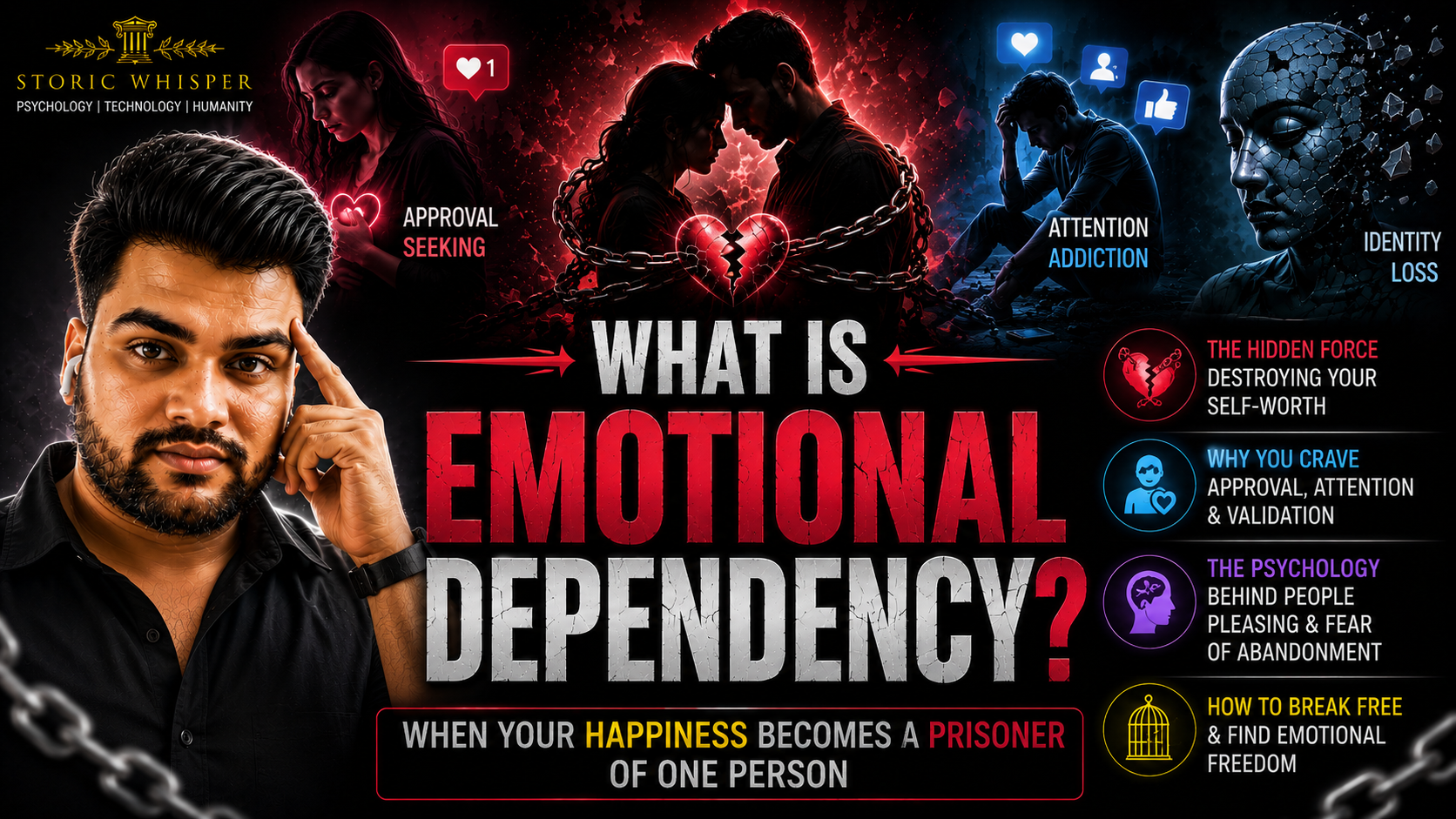
What is Emotional Dependency? When Your Happiness Becomes Someone Else’s Slave
Storic Whisper • Global Psychology Edition
Have you ever noticed how a single ignored text, a cold reply, or just a few hours of radio silence can completely hollow you out from the inside? When they talk to you with warmth, a sudden surge of electric energy runs through your veins. But the moment their tone shifts, the ground beneath your feet vanishes. You find yourself freefalling into a dark, freezing void.
Let’s be honest. This isn’t love, affection, or "caring too much." This is an invisible cage that psychology calls Emotional Dependency.
In plain terms, it is a psychological state where you take your happiness, your mental peace, your confidence, and your entire sense of Self-Worth and slide it right into someone else’s pocket. And here is the twist—this other person doesn't have to be a romantic partner. It could be a spouse, a parent, a best friend, a boss, or even the validation of strangers through metrics on social media.
The exact moment your brain internalizes the belief that "My happiness and my value as a human being are zero without this person," you step into a devastating trap. Have you unconsciously walked into this cage? Let’s dissect the deep, quiet machinery of this psychological game—because if you don’t understand this truth today, you will spend your entire life dancing to someone else's tune, never truly knowing who you are.
Part 1: What is Emotional Dependency? (The Psychological Mechanism)
Most people dismiss emotional dependency as simply "loving too hard" or being "possessive." But that is just a surface-level symptom. The underlying Psychological Mechanism is far more sinister, slowly hijacking your entire sovereignty.
Behavioral science reveals that every human being possesses an internal compass called the Locus of Control.
- A mentally resilient individual operates from an Internal Locus of Control—meaning their happiness and self-worth are anchored in their own principles, self-respect, and internal evaluation.
- An emotionally dependent person, however, shifts entirely to an External Locus of Control. You hand the keys to your kingdom to an outsider.
[Healthy Mental Model (Internal)]
Your Self-Worth ──> Internal Stability ──> Grounded & Balanced Connections

[Emotional Dependency Model (External)]
Their Micro-Mood/Attention ──> Your Self-Worth ──> Chronic Mental Anxiety
When this dependency crosses a critical threshold, a brutal process known as Identity Fusion takes over. You don't just love the person; you dissolve your personality into theirs. Your personal boundaries blur, your unique likes and dislikes fade, and you cease to exist as an independent entity. You become a mere shadow, mimicking their moods and desires just to stay safe.
This explains a massive mystery: When that person pulls away or denies you attention, why don't you just feel sad? Why does it feel like your entire universe is collapsing? It happens because your nervous system does not interpret this space as a normal ending; it flags it as an Existential Crisis—a literal threat to your survival. This isn't just a broken heart; it is the snapping of your psychological spine.
But how does a human being become this vulnerable? Does this fragility appear overnight, or was the script written long ago?
Part 2: How Emotional Dependency is Born
No one wakes up one morning completely powerless. The roots of this condition crawl deep into your past, your childhood wounds, and the hardwiring of your brain. Four major psychological forces drive this conditioning:
1. Attachment Theory (The Science of Bonding)
Relationship psychology shows that our early interactions with parents or primary caregivers write the hidden blueprint for how we love as adults. To map your own internal blueprint, explore our comprehensive guide on What Is Attachment Theory?.
If your childhood was unstable—where love was conditional, unpredictable, or emotionally vacant—you likely developed an Anxious Attachment Style. Adults with this style live in constant, low-grade terror of being abandoned. They subconsciously try to fill that ancient childhood vacuum by latching onto a partner, becoming entirely addicted to their presence.
2. Childhood Conditioning (The Compliance Program)
Were you praised as a child only when you suppressed your own needs to make adults happy? When a child is conditioned to believe that "pleasing others is the only way to be loved," they grow up into a Chronic People-Pleaser. Their self-worth dependency is programmed early: If I am not making them happy, I have no value.
3. Validation Hunger (The Void)
This is the dark, empty room inside you that you never filled with self-acceptance. When an individual suffers from an internal deficit of self-love, they are forced to beg for it from the outside world. This deep-seated craving is detailed in our psychological breakdown of What Is Validation Psychology? The Hidden Force Behind Self-Worth. Until someone else praises your looks, validates your work, or approves of your life, you feel invisible.
4. Fear of Abandonment (The Primal Panic)
This is an ancient, terrifying dread. It is the voice whispering: "If this person leaves, I will die in the cold." This primal panic paralyzes the rational brain. To avoid the horror of being alone, people tolerate disrespect, toxic behavior, and emotional breadcrumbs, because to them, isolation feels far worse than abuse. This level of submission is an unconscious byproduct of systemic behavioral design, a concept we dissect in The Architecture of Control: Decoding the Hidden Forces of Psychological Stagnation.
But how does this panic manifest in your daily life? Let’s strip away the romanticized labels and look at the real behavioral metrics.
Part 3: The Hidden Signs of Emotional Dependency
This psychological trap is a master of disguise. It frequently masquerades as "unconditional love," "deep loyalty," or "extreme empathy." Look closely at these Hidden Signs and ask yourself honestly if this is your life:
- The Inability to Say "No": You agree to demands that cross your moral boundaries or drain your energy, solely because you dread the friction or the distance a "No" might cause.
- Extreme Emotional Volatility: Your entire day is dictated by the micro-expressions of another person. A slightly cold tone from them in the morning entirely freezes your productivity for the afternoon.
- The Slow Murder of Identity: You quietly drop the hobbies you loved, stop seeing the friends who stood by you, and alter your opinions to match theirs. Your world shrinks until it fits entirely inside their orbit.
- Compulsive Monitoring: You find yourself obsessively tracking their online status, counting the minutes it takes them to reply, or analyzing their social media interactions. This behavioral loop never brings peace; it only feeds the anxiety.
- Isolation Panic: The moment you are left alone with your thoughts for a weekend or even a few hours, relaxation eludes you. Instead, a heavy, suffocating anxiety creeps in, because your own company has become unbearable.
If these patterns mirror your daily existence, the psychological cost is catastrophic. But why do some individuals remain trapped in these loops for years while others break clean?
Part 4: The Anatomy of Being "Stuck"
Why is it that after a breakup or the loss of a connection, some people process the grief and rebuild their lives within weeks, while others remain shattered, living in the ruins of a past relationship for years?
Cognitive science points directly to the Zeigarnik Effect—the psychological phenomenon where the human mind obsessively dwells on incomplete or unresolved situations far more than completed ones. When a relationship suffers an Abrupt Ending without clear closure, the brain gets trapped in an infinite loop of Rumination. You replay old scenarios twenty-four hours a day, asking the same desperate question: "What did I do wrong? Why wasn't I enough?"
People who stay stuck for years aren't actually mourning the loss of the real person. They are prisoners of the Hope Trap—the toxic belief that some sudden miracle will rewrite history and fix what is broken. This hope isn't inspiring; it is an emotional anchor keeping you from healing.
You are not attached to the human being; you are attached to the symbol of the future you built in your mind. When they left, your identity shattered with that dream, and you mistook the wreckage for your actual self. To understand how the human brain processes this shattering of ties, view our scientific breakdown on The Dopamine Trap: What is Dopamine?.
Part 5: The Brain Science (The Neurobiology of Dependency)
If you still believe this is just an emotional weakness or a sentimental "matter of the heart," you are drastically misunderstanding the human brain. Emotional dependency is backed by a brutal chemical reality. When your dependency is threatened, your brain undergoes the exact same patterns as a physical crisis:
1. Nervous System Threat Response
Neuroscience studies show that when a human brain experiences severe romantic rejection or emotional abandonment, the Anterior Cingulate Cortex lights up. This is the exact region of the brain that processes physical pain. In terms of neural firing, a severely broken heart hurts exactly like a broken bone or a physical burn. Your nervous system perceives it as a life-threatening predator attack.
2. Biological Identity Loss
When you depend completely on someone, your brain’s neural pathways literally integrate that person into your neurological map of "Self." They are no longer an external entity; they are a part of your biological operating system. When they leave, the brain experiences a profound 'Cognitive Disorientation,' reacting as if a physical limb has been amputated without anesthesia.
3. The Dopamine Withdrawal State
Receiving intense attention or validation activates your brain's reward loop in the exact same manner as highly addictive substances. The moment that person pulls away, your brain plunges into a severe Dopamine Deficit State—a literal state of drug withdrawal. You are no longer acting out of love; you are acting out of a chemical craving to escape the agonizing crash of withdrawal. This neurological loop is further amplified by modern digital interfaces, which we break down in How AI is Rewiring the Human Mind.
4. The Oxytocin Crash
While dopamine fuels the high of the chase, Oxytocin is the hormone responsible for long-term bonding, deep trust, and emotional security. When an intense attachment bond is severed, your oxytocin levels crash instantly, leaving your body in an unmitigated state of panic, deep isolation, and biological insecurity.
How do we reverse this chemical hijacking? The resolution requires a calculated, strategic reset of your psychological architecture.
Part 6: Recovery (The Blueprint for Sovereignty)
If your mental equilibrium has become a slave to another person's whims, the time has come to stage a quiet revolution. To break free from this neurochemical cage, you must execute a strategic, scientific reset:
1. Commit to No Contact Psychology (The Clean Break)
Addiction research demonstrates that the only way to heal a hijacked reward pathway is to completely remove the drug-conditioned cues that trigger the craving. This is known as Conditioned Inhibition. You must completely halt the checking of social media, erase the old chat logs, and pack away the photographs. This is a critical medical intervention to allow your dopamine pathways to drop back to baseline.
2. Relocate Your Locus of Control
You must deliberately stop importing your self-worth from external markets. Start manufacturing it domestically. To execute a comprehensive internal restructuring, read our definitive manual on What Is Self-Transformation? The Science of Personal Evolution. When you invest heavily in your own growth, your self-worth stops being an item someone else can buy or steal.
3. Process the Grief Without Escape
Attempting to outrun the pain by jumping into a rebound relationship or numbing yourself with distractions only freezes the trauma. It prolongs the healing timeline indefinitely. Let the sadness hit you. Sit quietly in the empty room. Let your nervous system experience the discomfort and slowly learn a vital biological truth: This hurts terribly, but it is not going to kill me.
4. Erect Uncompromising Boundaries
Start small, but start immediately. If something does not align with your time, your values, or your peace of mind, practice saying "No" without offering an essay of excuses. The first time you calmly set a boundary and survive the irrational guilt that follows, your dormant self-confidence will wake up.
🏛️ The Sovereign Verdict
To be emotionally independent does not mean you must transform into a cold, unfeeling machine, refuse to love, or live like an isolated ascetic in a cave. We are humans; deep attachment and intimacy are beautiful, biological necessities of our species.
But there is a grand canyon of difference between a healthy relationship (Interdependence) and mental slavery (Dependency).
A healthy connection consists of two whole, autonomous individuals who join hands to experience the beauty of existence together. Emotional dependency is when you look at yourself as a fractured, half-empty creature and hand someone else the contract to complete you. Stop putting your happiness up for a public vote. Your ultimate value is never determined by how much attention someone pays you; it is determined by how heavily your self-respect holds its ground when the room is dead silent and you are looking at your own reflection. This unshakeable posture is the exact foundation explored in our core analysis: Why Is Stoicism Becoming So Popular in the Modern World?.
Storic Whisper — Without noise, your path to mental sovereignty.